Tonga — humpback whale below the surface in the blue Pacific

Kingdom of Tonga, South Pacific · The Last Pacific Monarchy

Tonga

The only country on earth where swimming with humpback whales is legal. The mother and calf at 5 metres in the August calm. The Ha'apai overwater bungalow. The Sunday silence. The last Pacific kingdom that was never colonised.

No need to read on

Skip ahead — plan your Tonga escape now.

Tell us your dates and your pace. Personalised suggestions, never confirmed reservations.

Plan My Escape — £19.99

The Case for Going

The only country in the world where swimming with humpback whales is legally permitted — and the Pacific kingdom that was never colonised, retaining the most intact Polynesian culture in the region.

The humpback whale encounter in Tonga is the most extraordinary single wildlife experience legally available in any ocean. The whales (the Tonga–Antarctica population, approximately 3,000 individuals, identified by the unique pattern on the underside of each animal's tail flukes) breed and calve in Tongan waters between June and November; the Tongan government, which permits in-water encounters with the whales under a strictly licensed operator system, has created the conditions for an experience that is available nowhere else: entering the water alongside a 40-tonne animal that is neither distressed nor aggressive, observing it at close range in the clear blue water of the Vava'u or Ha'apai lagoon as it carries out the intimate activities of breeding and calf-rearing.

The Kingdom of Tonga (the official name — Tonga is ruled by King Tupou VI, the latest monarch in a dynasty that has governed the islands since 1845) is the only Pacific island nation never formally colonised by a European power, a distinction that has allowed Tongan culture, language, and traditional social structure to develop on their own terms. The Sunday Sabbath (observed with a strictness found nowhere else in the Pacific — no commerce, no vehicles, the churches full at 08:00 and again at 18:00) is the most visible expression of a cultural self- determination that the rest of the Pacific has had to reconstruct after colonial disruption.

The infrastructure is basic. The journey is long. The whale encounter is, in the testimony of most visitors who have experienced it, among the most affecting events of their travelling lives.

The Destination at a Glance

176 islands across four groups — Tongatapu, Ha'apai, Vava'u, and the Niuas — stretching 800 kilometres from north to south across the South Pacific.

Tongatapu (the main island, home to the capital Nuku'alofa and the royal palace, 70% of Tonga's 100,000 population) is the gateway — the international airport, the government ministries, and the most developed infrastructure in Tonga, though 'developed' is relative: Nuku'alofa is a small Pacific capital with a morning market, a central post office, and a Sunday silence that descends on the entire island from midnight Saturday to midnight Sunday.

The Vava'u Group (35 islands, the sailing and whale swimming capital of Tonga, accessed by Real Tonga prop-plane from Nuku'alofa in 45 minutes) and the Ha'apai Group (the most remote, the most ecologically pristine, the least visited, accessed by prop-plane in 35 minutes) are the whale swimming destinations. Most Tonga itineraries combine a Tongatapu night (the Ha'amonga trilithon, the royal tombs, the flying foxes) with four to six nights in Vava'u or Ha'apai for the whale season.

Best Time to Visit

When to go.

Jun – Nov

Whale Season

The humpback whale season: June arrivals, November departures. Peak encounter probability August–September. The only reason most visitors come to Tonga. Book whale swimming operators 4–6 months in advance for August–September.

Dec – May

Whale-Free Season

The whales are in Antarctica. Tonga in the off-season: the sailing, the Ha'apai reef diving, and the cultural immersion without the August whale tourism crowd. Cyclone risk January–March; the Vava'u group is less exposed than Tongatapu.

Our Pick

August

The peak of the whale season: mother-and-calf pairs most reliably present, male competition groups at maximum activity, and the encounter weather (flat calm, clear visibility) most consistent. Book a year in advance for August at the Treasure Island or Mandala operators.

Where to Stay

Five worth knowing.

01

Fafa Island Resort

Fafa Island, Tongatapu Group

25 fale (traditional Tongan open-sided bungalows) on a private island 45 minutes by boat from Nuku'alofa — the most established and most consistently atmospheric small resort in the Tongatapu Group, a palm-fringed coral island entirely occupied by the resort. The Fafa Island's private island character (the ferry from the capital arrives twice daily, otherwise the island is entirely the resort's) and the fringing reef (snorkelling from the beach in water of 3–8 metres depth, the reef in good health on Fafa's northern and eastern shores) make it the most immediate Tongan resort experience from the gateway island. The resort restaurant (serving traditional Tongan umu-cooked food — the underground earth oven technique, fish and taro wrapped in banana leaves and cooked in volcanic stones — on Friday evenings, the most authentic Tongan food experience available at any resort) and the proximity to the Tongatapu flyingfox colony (the largest bat colony in the southern hemisphere, several hundred thousand fruit bats roosting in a grove 20 minutes from the island by boat, the most remarkable wildlife encounter in accessible Tonga) distinguish it.

Best for

Couples who want the most immediate and most atmospherically Tongan luxury island experience from the capital — the Fafa Island's private island character, the Friday umu dinner, and the Tongatapu flyingfox boat trip make it the most culturally engaged resort in the gateway island group.

02

Mandala Resort

Pangai, Ha'apai Group

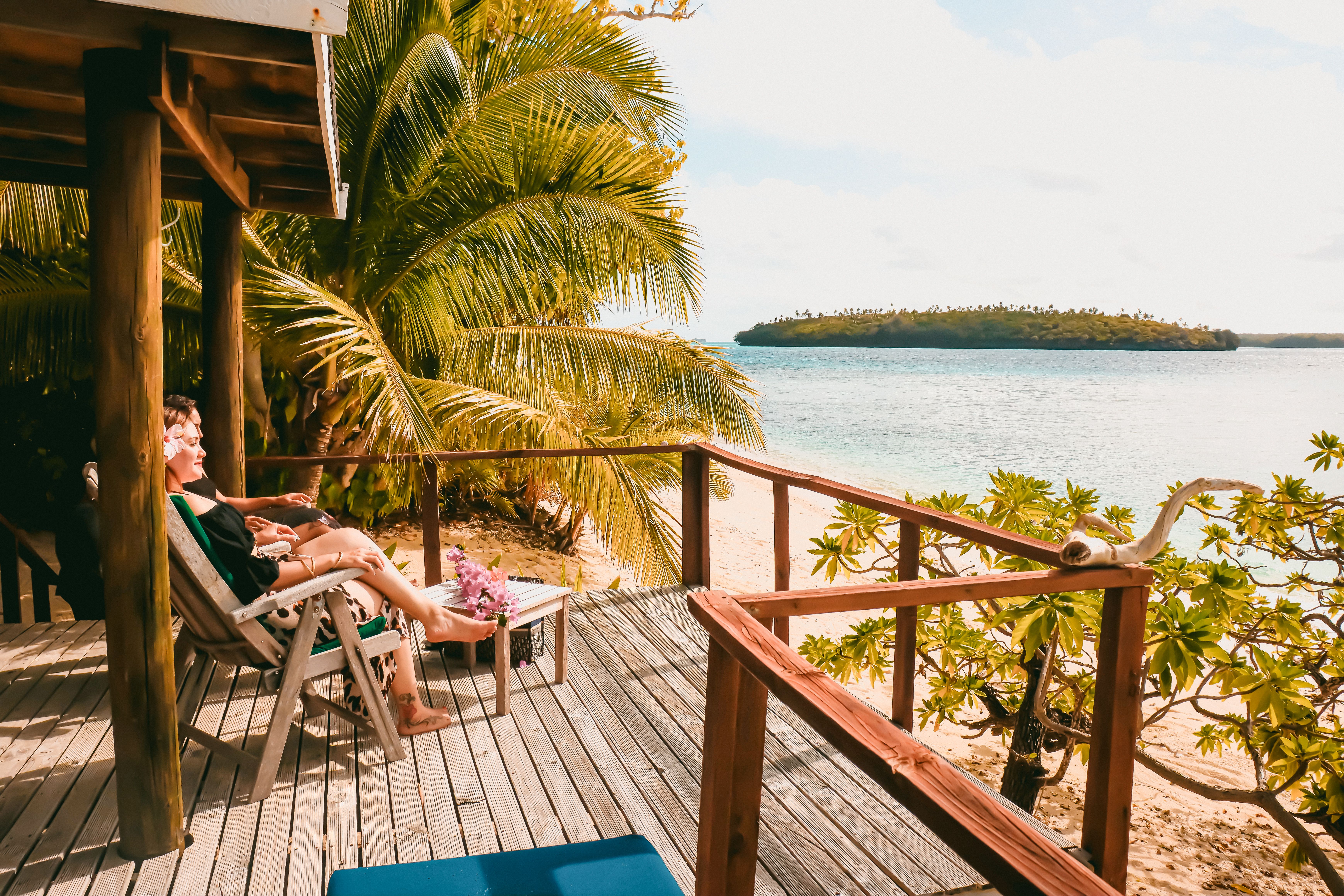
Five overwater bungalows in the Ha'apai Group — the most remote and least visited of Tonga's island groups, a chain of low-lying coral islands and shallow lagoons in the central Tongan archipelago, the waters that Herman Melville sailed in 1842 and described as 'the fairest of all the Pacific.' The Ha'apai overwater bungalows are the least-known overwater accommodation in the Pacific: positioned above a crystal lagoon in a group that receives fewer than 1,000 tourist visitors per year, the Mandala offers a level of isolation and exclusivity that the more developed island groups (Vava'u, Tongatapu) cannot match. The whale swimming programme (humpback whales calve and court in the Ha'apai Group's warm waters, the same population as the Vava'u Group but with far fewer licensed operators competing for encounters) is the most private and least crowded available in Tonga.

Best for

Couples who want the most remote overwater bungalow experience in the South Pacific with the least crowded humpback whale swimming programme — the Mandala's Ha'apai Group position, the five-bungalow maximum, and the private whale encounters make it the most exclusive whale swimming base in Tonga.

03

Sandy Beach Resort

Neiafu, Vava'u Group

20 bungalows on a hillside above the Vava'u Island group's main port of Neiafu — the most comprehensively activity-focused resort in Tonga, positioned at the heart of the sailing and whale swimming circuit that makes Vava'u the most visited island group in Tonga. The Sandy Beach's whale swimming programme (half-day boat excursions departing from the resort dock, a licensed operator in the Vava'u whale swimming zone) and the sailing charter connection (the Vava'u Group's 50+ anchorages accessible by bareboat or skippered yacht charter, the most complete cruising area in the South Pacific) make it the most operationally complete resort in the whale swimming zone. The food programme (fresh yellowfin tuna, wahoo, and dorado from the charter boat's daily catch, prepared with Tongan spice combinations on the open kitchen's grill) is the most reliably fresh in Tonga.

Best for

Couples who want the most operationally complete whale swimming and sailing base in Tonga — the Sandy Beach's Vava'u position, the in-house whale swimming programme, and the sailing charter connections make it the best all-activity resort in the whale watching zone.

04

Treasure Island Eco Resort

Hunga Island, Vava'u Group

Three bungalows on a private island in the Vava'u Group — the most intimate and most ecologically managed whale swimming property in Tonga, operated by a marine biologist who has been studying and managing the Vava'u humpback population for 20 years. The Treasure Island's three-bungalow maximum means that each whale swimming excursion goes out as a group of six (three couples maximum), and the marine biologist guide provides the most scientifically current humpback whale information available from any Tonga operator. The island's fringing reef (no other boats in the surrounding anchorage, the clearest water in the Vava'u Group) and the private beach make it the most completely isolated luxury property in Tonga.

Best for

Couples who want the most scientifically guided and the most intimately scaled whale swimming experience in Tonga — the Treasure Island's three-bungalow maximum, the marine biologist operator, and the private island isolation make it the most exclusive whale encounter programme in the South Pacific.

05

Blue Lagoon Beach Resort

Ha'atafu Beach, Tongatapu

22 bungalows on Ha'atafu Beach, the most celebrated surfing beach on Tongatapu — a reef-break point surf that the Blue Lagoon manages as a surf-focused adults-preferred resort. The Ha'atafu reef break (one of the most consistent left-hand reef breaks in the South Pacific, accessible by boat from the resort dock, working best in the July–October swells that the Tongatapu Group's exposed western coast receives directly from the Southern Ocean fetch) and the surf school programme (operated by the same family that has run the resort since 1985, the longest-established surf operation in Tonga) make the Blue Lagoon the most activity-specific resort on the gateway island. Non-surfers: the resort's snorkelling (Ha'atafu's reef is in better health than the Nuku'alofa urban reefs) and the beach walk to the fishermen's village at the reef's northern end are the best non-surf activities.

Best for

Couples where one or both surf, or where a surf lesson is on the agenda — the Blue Lagoon's Ha'atafu reef access, the family surf school programme, and the affordable Tongatapu pricing make it the best surf and resort combination in the gateway island.

Whales, Sailing & Kingdom Culture

What to do.

Swimming with humpback whales

The encounter begins with the operator spotting the whale from the boat (typically 10–30 minutes from the resort departure, the whale's blow visible at 500–1,000 metres in the flat Vava'u calm) and approaching to a position downwind and ahead of the whale's direction of travel. The guide enters the water first, observes the whale's behaviour, and gestures to the group if the approach is appropriate. The swimmers enter in silence (fins only, no tanks, no loud movements), kicking to a position 5–10 metres from the whale, and observe from the surface. The whale is typically aware of the swimmers from the moment of water entry — the humpback's curiosity means that some individuals approach the swimmers deliberately, circling the group at close range, the rostrum (the bumpy whale's snout) sometimes within 2 metres. The encounter lasts from 10 minutes to 45 minutes depending on the whale's willingness to remain in the area. Some days produce multiple encounters. This is the most extraordinary wildlife experience available in any ocean.

Ha'amonga 'a Maui trilithon

The Ha'amonga 'a Maui (the 'Burden of Maui' in Tongan mythology) is a coral stone trilithon — two upright coral columns supporting a horizontal lintel, built approximately 1200 CE, the most significant and most enigmatic pre-European monument in Polynesia. The structure (each coral block weighing approximately 40 tonnes, transported from a coral quarry on the island's lagoon and raised without metal tools or wheeled vehicles) was initially interpreted as a royal gateway; the discovery of solar alignment markers carved on the lintel's top surface (visible to a visitor standing on a ladder) suggests an astronomical calendar function — the trilithon's alignment with the December solstice sunrise and the June solstice sunset is the most sophisticated astronomical achievement in pre-European Polynesian architecture. The site is quiet, unmonitored, and entirely accessible without tourist infrastructure — the most affecting archaeological encounter available in Tonga.

Vava'u sailing charter

The Vava'u Group's 50+ anchorages (Port Maurelle, the Port of Refuge, the Swallows Cave, the Mariner's Cave, and the isolated southern islands of the group, each with a distinct character and a distinct snorkelling reef) constitute the most complete cruising area in the South Pacific for a yacht under 60 feet. Bareboat charter (a self-skippered monohull or catamaran from the main charter operators in Neiafu harbour, the Vava'u fleet the most diverse in Tonga) and skippered charter (a professional Tongan or expat captain managing the passage while the guests focus on the snorkelling and the whale watching) are both available from Neiafu. The Mariner's Cave (a submerged cave entrance on the northeastern Vava'u coast, accessible only by diving under a coral shelf and surfacing inside the completely enclosed cave — the interior lit by refracted light entering through the underwater entrance) is the most technically demanding but most extraordinary single destination in the Vava'u sailing circuit.

Sunday church service

The Tongan Sunday church service — attended by virtually the entire population, the congregation dressed in formal Tongan dress (the men in ta'ovala pandanus leaf mats wrapped around the waist, the women in formal puletaha outfits with kiekie waist decoration) and singing the four-part harmonised hymns that are the most beautiful communal music in the Pacific — is the most accessible and most genuinely welcoming cultural experience in Tonga. Visitors are invited to attend (the service is typically conducted in Tongan, with a brief English welcome for visitors) at any of the island's churches from the Methodist (the largest denomination, the most elaborate harmonies) to the Free Wesleyan and the Catholic. The post-service Sunday feast (the umu-cooked meal of taro, suckling pig, octopus, and sweet potato, shared by the family and available to invited visitors) is the most culturally complete food experience in the Pacific.

What to Eat and Drink

Umu-cooked suckling pig on Sunday, fresh yellowfin tuna from the charter boat, and the ota ika fish salad with coconut cream.

Tongan cuisine is rooted in the umu earth-oven tradition — the underground cooking method using heated volcanic stones to steam-cook parcels of food wrapped in banana leaves, the technique producing the most judiciously seasoned and most tender versions of the island's staple proteins (suckling pig, chicken, fish) and starchy vegetables (taro, cassava, kumara sweet potato). The Sunday umu feast (prepared after the morning church service and eaten in the early afternoon) is the most culturally significant eating experience in the Tongan calendar and the most directly immersive food encounter available to visitors.

Ota ika (the Tongan version of Pacific fish ceviche — raw fish marinated in lime juice and coconut cream, with tomato, cucumber, and chilli, the Tongan preparation distinguished by the use of the local 'ota ika' fish — any fresh white-flesh reef species, the wahoo or the mahi-mahi ideal) is the defining casual dish of the islands. The local kava (the same root-based social drink as Fiji's, prepared in the identical communal bowl ceremony) is the drink; the Vava'u Group's yacht bars (the Mango Cafe, the Dancing Rooster) produce the most convincing rum cocktails available in the Tongan Islands.

The Bespoke Horizons View

The world's most extraordinary wildlife encounter, in a kingdom that has maintained its cultural sovereignty for 200 years. Go in August. Bring nothing you don't need.

Tonga is not a destination to visit for the hotels, the food, or the infrastructure — all of which are modest by the standards of French Polynesia or Australia. It is a destination to visit for the humpback whales and for a culture that has not been softened into a tourist experience. The Sunday silence, the church hymns, the umu feast in a Tongan family's home: these are not attractions. They are just Tonga, doing what Tonga does on a Sunday.

Our recommendation: book the Ha'apai Group's Mandala Resort or the Treasure Island in Vava'u for the most private whale encounters, arriving in the first week of August (before the peak August weekend crowd from New Zealand and Australia), and staying eight nights. One night in Nuku'alofa (the ha'amonga trilithon in the afternoon, the flying fox colony at dusk) is necessary and sufficient for the gateway island. The rest should be spent in the water.

The humpback whale at 5 metres. Her calf rising to breathe beside her. You in the water between them, doing nothing except being present. This is the most extraordinary thing available in the Pacific.

Essential Information

The practical detail.

Currency
Tongan Paʻanga (TOP); USD accepted at some resorts; exchange in Nuku'alofa or bring USD
Language
Tongan and English (both official); English spoken at resorts and in the tourist circuit
Flights from UK
Fua'amotu International Airport (TBU), Nuku'alofa, served from London via Auckland (Air New Zealand, 24 hours) or via Fiji (Fiji Airways/Real Tonga, 25 hours); domestic flights to Vava'u (VAV) and Ha'apai (HPA) by Real Tonga twin-props
Time zone
GMT +13 (TOT; Tonga does not observe daylight saving — it is permanently on UTC+13, the first inhabited territory to greet each new day)
Visa
No visa required for UK citizens for stays up to 31 days; extendable to 90 days on application in Nuku'alofa
Whale swimming season
Humpback whales are present in Tongan waters from June through November, with peak activity and the most reliable encounters in August and September. The encounters (in-water swimming with the whales, the only country in the world where this is legally permitted) are regulated by the Tongan government: licensed operators only, maximum 10 swimmers per whale, no flash photography. Book whale swimming operators as part of the accommodation booking — the best operators and the best guides fill their season months in advance.
Tonga's identity
Tonga is the only Pacific island nation never colonised by a European power — the Tongan monarchy negotiated protectorate status with Britain in 1900 but retained sovereignty, and the royal family (the House of Tupou) has ruled Tonga continuously since the 1840s. The Kingdom of Tonga: the last Pacific monarchy.
Budget range
Fafa Island Resort from £200 per fale per night; Mandala Resort from £300 per overwater bungalow; Treasure Island from £400 per bungalow; Blue Lagoon from £120 per bungalow

Frequently Asked

Questions, considered.

Plan Your Tonga Escape

Your personalised Tonga whale swimming itinerary, in your inbox within minutes.

The best licensed whale swimming operator, the Ha'apai vs Vava'u decision, the August peak booking strategy, and the Tongatapu cultural stop — the Tonga itinerary that puts you in the water with the whales.

Bespoke Horizons provides personalised travel planning and itinerary suggestions. We are not a booking agent and all recommendations are non-binding.

Ready to plan your Tonga escape?

Plan My Escape — £19.99