Oman — mountains, desert, and the Musandam fjords

Arabian Peninsula · Desert, Mountains & Fjords

Oman

Alila Jabal Akhdar at 2,000 metres above the Al Hajar canyon, the Wahiba Sands dune sea at night, and the fjords of Musandam that the tourist buses never reach. Arabia, unmediated.

No need to read on

Skip ahead — plan your Oman escape now.

Tell us your dates and your pace. Personalised suggestions, never confirmed reservations.

Plan My Escape — £19.99

The Case for Going

The Arab world's most hospitable country, with the landscapes to match.

Oman is the Arab world's most consistently underrated destination among Western luxury travellers — and the one that those who discover it tend to return to. The reason is specific: Oman has landscapes of extraordinary diversity (desert, mountain at 2,000 metres, fjord, and fertile wadis) that are almost entirely without the commercial tourism infrastructure that covers comparable landscapes in Jordan, Egypt, or the UAE. The Wahiba Sands dune sea is twelve times the size of the Sahara's most-visited sections and almost empty.

The hotel infrastructure has arrived quietly and remarkably well: Alila Jabal Akhdar, perched on a cliff edge at 2,000 metres above a rose-growing valley, is the most dramatically positioned hotel in the Arabian Peninsula. Six Senses Zighy Bay, accessible by paraglide descent to a private beach in the Musandam fjords, is the most secluded. The Chedi Muscat remains the benchmark city hotel in the Gulf for considered design and consistent service.

For couples who want the landscape, the cultural depth, and the quality hotel alongside an absence of the transactional tourism of Dubai and Abu Dhabi, Oman is the Arabian Peninsula answer that the glossy magazines have been slow to name.

The Destination at a Glance

A sultanate of 309,500 square kilometres: desert, Al Hajar Mountains, the Musandam fjords, and 3,000 years of maritime trade.

The Sultanate of Oman occupies the south-eastern corner of the Arabian Peninsula, bordered by Saudi Arabia, the UAE, and Yemen. Muscat International Airport (MCT) receives direct flights from London Heathrow (approximately 7.5 hours on British Airways and Oman Air). The country's landscape divides into the coastal Hajar Foothills around Muscat, the interior plateau and Wahiba Sands desert, the Al Hajar mountain range rising to 3,000 metres, and the exclave of Musandam in the far north (separated from mainland Oman by a strip of UAE territory).

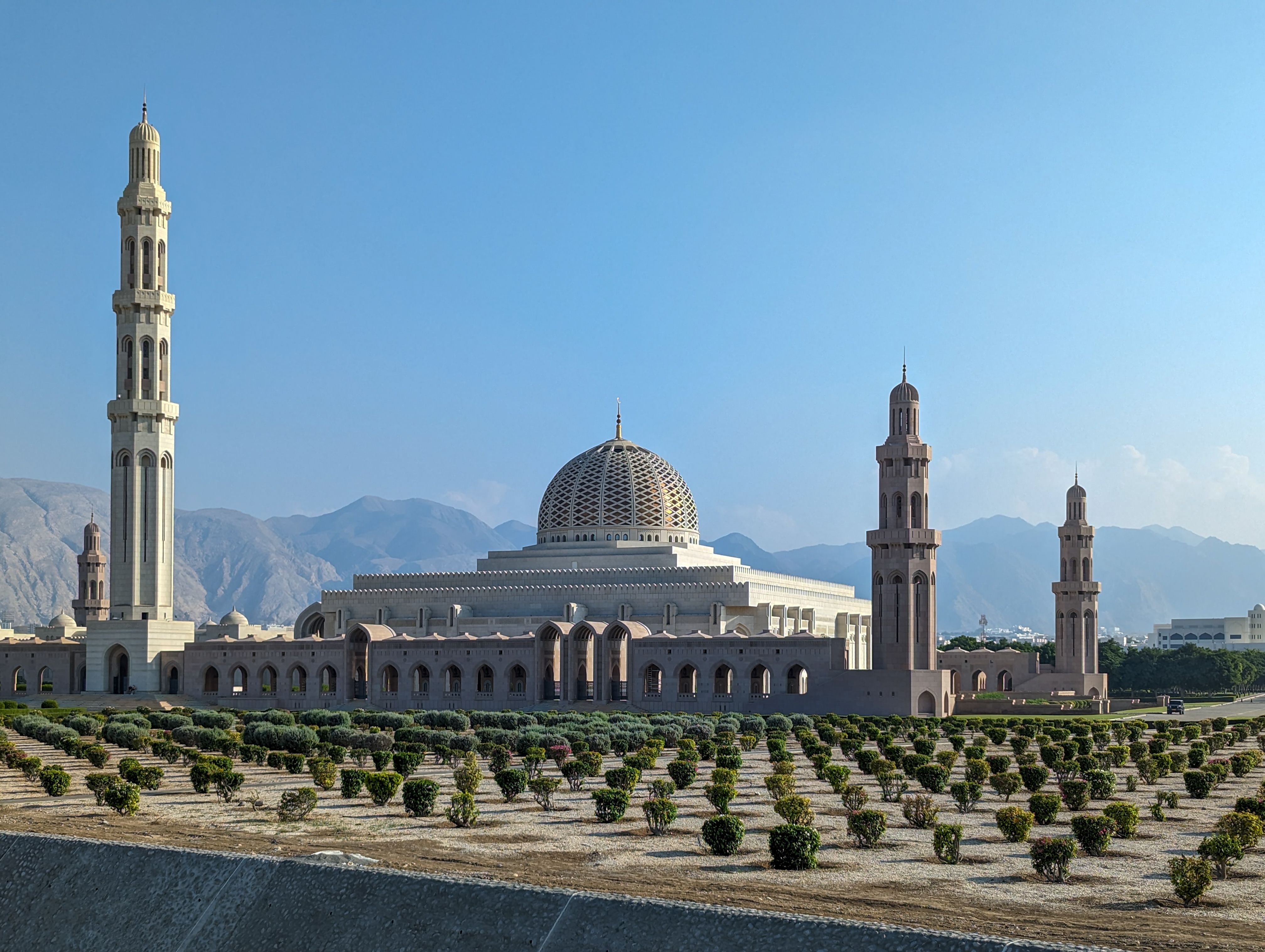
Oman follows Ibadi Islam — a moderate tradition distinct from both Sunni and Shia Islam — and is the world's most practised example of this branch. The Sultan Qaboos Grand Mosque in Muscat (one of the world's largest mosques, completed 2001) is open to non-Muslim visitors in the morning and is Oman's most visited site. Muscat's Muttrah Souq, the most authentic traditional market in the Gulf, has been trading since the 13th century.

Best Time to Visit

When to go.

Oct – Mar

Peak Season

The most comfortable window: 20–30°C in Muscat, cooler in the mountains. December and January are below 5°C at Alila Jabal Akhdar at night. The desert stargazing is clearest October–November.

Apr – Sep

Extreme Heat (lowlands)

Muscat and the desert reach 45°C+ in summer. The Al Hajar mountains remain comfortable. Salalah (far south) experiences the unique Khareef monsoon June–September, turning dry landscape green.

Our Pick

November

Crisp, clear, and uncrowded. The desert at its most atmospheric for night stargazing. The mountain at perfect hiking temperature. Muscat empty of summer domestic tourism.

Where to Stay

Five worth knowing.

01

Alila Jabal Akhdar

Al Hajar Mountains, Jabal Akhdar

The finest hotel in Oman, full stop: eighty-six rooms and residences at 2,000 metres above sea level on the edge of a dramatic cliff above a rose-growing valley in the Al Hajar mountain range. The infinity pool appears to overhang the canyon directly below; the views from the cliff-edge restaurant across the Wadi Bani Habib gorge at sunrise are among the most dramatic of any hotel in the Arab world. In the rose harvest season (spring), the valley below fills with the scent of rose water.

Best for

Couples who want Oman's most dramatic physical setting — the cliff-edge pool above the Al Hajar canyon is the most spectacular hotel position in the country.

02

Six Senses Zighy Bay

Zighy Bay, Musandam Peninsula

Eighty-two pool villas in a Bedouin-style village on a private beach in the Musandam Peninsula — the fjord-like enclave of Oman that extends into the Strait of Hormuz. Accessible by paragliding descent (the signature arrival), boat through the fjords, or road through the mountains. The Six Senses wellness programme is one of its most accomplished globally; the snorkelling directly from the beach on the Musandam reef is extraordinary.

Best for

Couples who want the Six Senses wellness programme in the most secluded and fjord-dramatic setting in Oman — and those who want to arrive by paraglide.

03

The Chedi Muscat

Al Khuwair, Muscat

The finest hotel in Muscat: 158 rooms and suites designed by Jean-Michel Gathy on a long strip of beach in Al Khuwair, with the longest hotel pool in the Middle East (103 metres), three restaurants of genuine quality, and an architecture that blends Omani craft traditions with contemporary resort minimalism. The Chedi is the Muscat base from which the mountain and desert excursions radiate; the long pool at sunset, with the Hajar Mountains visible to the north, provides the most cinematic city hotel experience in Arabia.

Best for

Couples who want the definitive Muscat base — the Chedi's position, pool, and consistency make it the reference address for the city.

04

Anantara Al Jabal Al Akhdar Resort

Al Hajar Mountains, Nizwa

The Anantara group's mountain property is Alila Jabal Akhdar's closest competition: 115 rooms and villas on the same mountain plateau, with equally dramatic canyon views and a slightly different aesthetic — less minimalist, more warm-toned, with a more comprehensive activity programme. The complimentary guided hiking routes cover canyon walks and mountain village visits not available from the Alila. A slightly fuller hotel experience for those for whom activities matter as much as aesthetics.

Best for

Couples who want the Al Hajar mountain drama with a more activities-focused programme — the canyon hiking and village walks complement the cliff-edge views.

05

Desert Nights Camp

Wahiba Sands desert

The finest luxury camp in the Wahiba Sands desert (Sharqiyah Sands), two hours south-east of Muscat: thirty tented villas in a campement style above the dune sea, with private plunge pools in the higher-category tents, guided dune walks at sunrise, and the most atmospheric stargazing in the Arabian Peninsula. The camp is not a resort; it is a base from which the desert is explored on foot, camel, and quad bike, and from which the night sky is most visible in the absence of any light pollution.

Best for

Couples who want the Wahiba Sands dune sea in a luxury camp context — sunrise on the dunes, Bedouin-style dinner under the stars, and the most complete absence of artificial light in Oman.

Dunes, Wadis & Frankincense Trails

What to do.

Wahiba Sands at dawn and dusk

The Sharqiyah Sands (Wahiba Sands) — a dune sea of 12,500 square kilometres in east-central Oman — are the most accessible of Oman's great desert landscapes. A full-day excursion from Muscat (2 hours) or a two-night stay at Desert Nights Camp covers the essential experiences: the dune ascent at sunrise (the dunes reach 150 metres), the camel ride at dusk, and the dinner under a night sky of extraordinary clarity in the complete absence of light pollution. The oryx, the sand gazelle, and the Bedouin heritage of the Wahiba tribe are the cultural dimensions.

Wadi Shab swimming

The wadis of Oman's interior — river gorges cut through limestone and granite by seasonal floods — are among the country's most photogenic natural landscapes. Wadi Shab, 130 kilometres south of Muscat, requires a boat crossing and a 45-minute walk through the narrow gorge before arriving at a series of fresh-water pools of extraordinary clarity. The final pool, reached by swimming through a passage in the rock, opens into a cave with a waterfall. This is not a resort experience; it is the country itself.

Sultan Qaboos Grand Mosque

The Grand Mosque in Muscat — completed in 2001 to mark the 30th anniversary of Sultan Qaboos's reign — is Oman's most visited site and one of the world's great contemporary mosques. The main hall accommodates 20,000 worshippers beneath a hand-loomed carpet of 21 tonnes (the world's second largest single-piece carpet at time of completion) and the world's largest chandelier at the time of installation. Non-Muslim visitors are admitted Saturday through Thursday from 8am to 11am; modest dress required.

Musandam fjords by dhow

The Musandam Peninsula — Oman's north-western exclave separated from the main territory by UAE land — is the most geologically dramatic landscape in Arabia: limestone mountains falling directly into the Strait of Hormuz in a fjord system of narrow inlets called khor. A traditional dhow charter through the Khasab fjords, with snorkelling stops in the warm sea and lunch on the boat, delivers a landscape that has no equivalent in the Gulf region. Dolphins frequently accompany the dhow through the narrow khor passages.

What to Eat and Drink

Slow-cooked lamb, shuwa, and the Omani coffee that precedes everything.

Omani cuisine is shaped by the country's maritime trading history: the spices of Zanzibar (Oman controlled much of the East African coast until 1856), the dried lime and cardamom of the Persian Gulf, and the slow-cooking traditions of the Bedouin interior. The shuwa — a whole lamb or goat marinated in spices, wrapped in banana leaves, and buried in an underground oven for 24–48 hours — is the national dish of Omani celebration: eaten on Eid, at weddings, and at the most traditional guesthouses. The shuwa available at Bait Al Luban in Muttrah is the most reliable restaurant version.

Omani coffee (qahwa) — cardamom-spiced, served pale gold in small handleless cups — and dates accompany every formal encounter and business meeting in Oman. The ritual of offering and accepting coffee is central to Omani hospitality; declining is considered impolite. The Muttrah fish souq serves fresh-caught hammour, kingfish, and tuna from the Gulf of Oman at prices and a quality that the hotel restaurants import from the same boats.

The Bespoke Horizons View

The Arab world that lives up to the idea of the Arab world.

The couples we send to Oman tend to arrive expecting the UAE and leave having found something considerably more rewarding. The landscape is the specific argument: the Al Hajar mountains, the dune sea, the Musandam fjords, and the wadis cannot be reproduced or replaced. The hotel product that has been built around this landscape — Alila at 2,000 metres, Six Senses in the fjords, the Chedi in Muscat — is as good as anything in the Middle East.

We build the week as Muscat (The Chedi, 2 nights), the Al Hajar mountains (Alila Jabal Akhdar, 2 nights), and the Wahiba Sands (Desert Nights Camp, 2 nights), with the Musandam Six Senses as an optional extension for those with the time. Oman rewards the couple who is willing to move rather than stay: the three landscapes make the country.

The Alila pool extends to the cliff edge above the canyon. Three thousand feet below, a rose valley. Frankincense burning somewhere in the hotel. Arabia, as it should be.

Essential Information

The practical detail.

Currency
Omani Rial (OMR); USD and cards accepted at luxury hotels
Language
Arabic; English very widely spoken, particularly in Muscat and hotels
Flights from UK
7–8 hours (direct Heathrow–Muscat on British Airways and Oman Air; daily)
Time zone
GMT +4
Visa
eVisa required for UK citizens: apply online, OMR 5, available on arrival or pre-arranged
Dress code
Modest dress in public; traditional souqs require covered shoulders and knees
Safety
Oman is consistently ranked the safest country in the Arab world for tourists
Budget range
£250–£1,200+ per person per night across the mountain and desert spectrum

Frequently Asked

Questions, considered.

Plan Your Oman Escape

Your personalised Oman itinerary, in your inbox within minutes.

The Chedi in Muscat, Alila at 2,000 metres above the Al Hajar canyon, the Wahiba Sands night sky — the Oman circuit that covers the country's three landscapes without a wasted day.

Bespoke Horizons provides personalised travel planning and itinerary suggestions. We are not a booking agent and all recommendations are non-binding.

Ready to plan your Oman escape?

Plan My Escape — £19.99