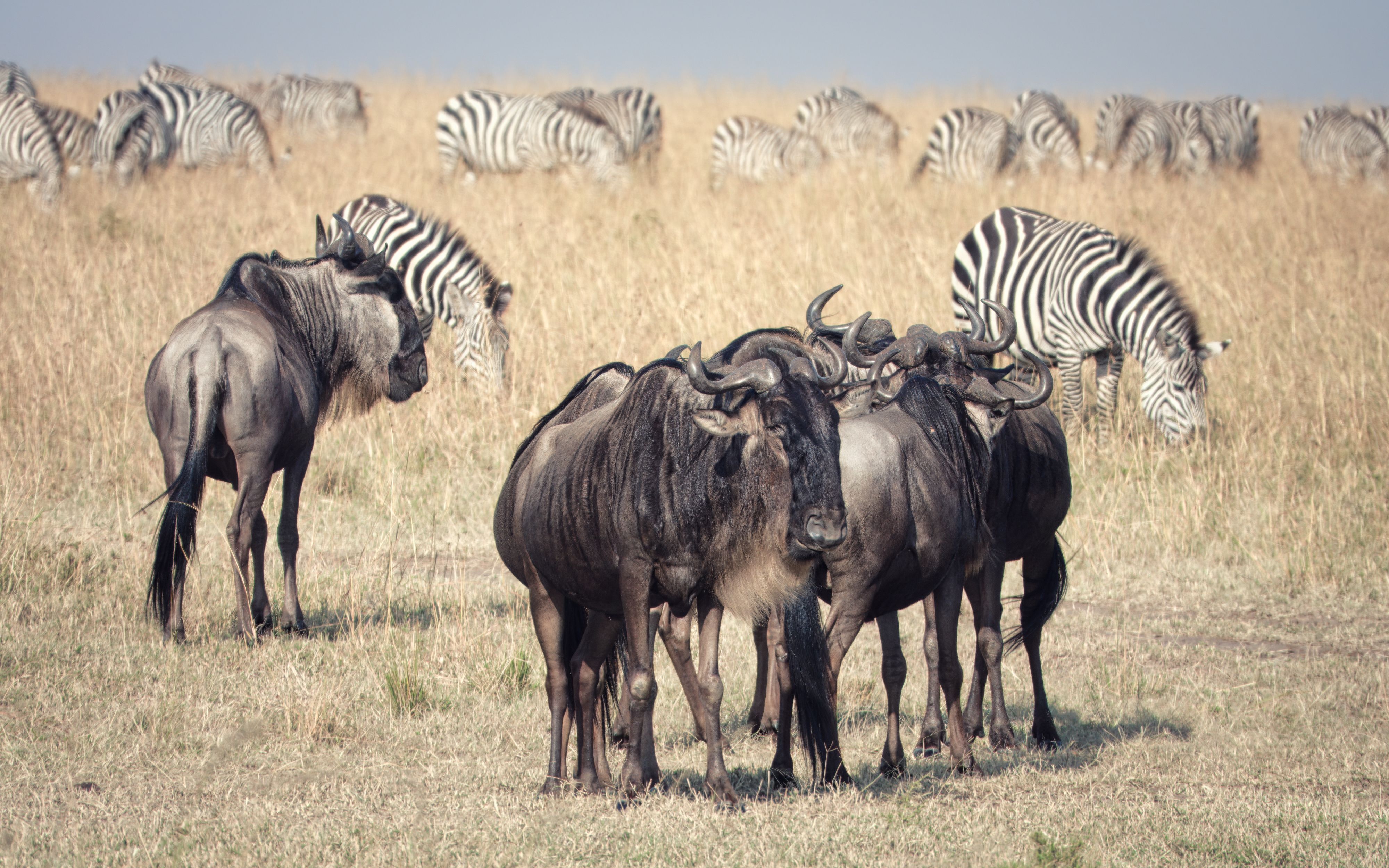
Masai Mara — the Great Migration on the Kenyan savanna

Kenya, East Africa · Savanna & Safari

Masai Mara

The Great Wildebeest Migration crossing the Mara River. Lion prides on the open plain at first light. Angama Mara's escarpment view over 1,500 square kilometres of savanna. Africa at its most unmediated.

No need to read on

Skip ahead — plan your Masai Mara escape now.

Tell us your dates and your pace. Personalised suggestions, never confirmed reservations.

Plan My Escape — £19.99

The Case for Going

The largest land migration on earth. 1.5 million wildebeest, twenty resident lion prides, and the most storied savanna in Africa.

The Masai Mara is the Kenyan northern extension of the Serengeti ecosystem — the same volcanic grassland, the same black cotton soil, the same acacia woodland corridors along the Mara River. But the Mara has characteristics that distinguish it from the Serengeti: a higher density of resident lion prides (the Marsh Pride monitored by Jonathan Scott since 1977; the Rekero Pride of the river crossing zones), a river system that runs year-round rather than drying in the dry season, and the escarpment edge (the Oloololo Escarpment) from which the entire Mara Triangle can be viewed from above.

The Great Migration — the annual movement of 1.5 million wildebeest and 200,000 zebra from Tanzania's Serengeti to the Mara's seasonal grass — produces the most dramatic wildlife spectacle on earth: the Mara River crossings (herds of thousands entering a river full of Nile crocodile, the wildebeest milling on the bank, the crossing beginning with a single individual that triggers the cascade) are the moment that most visitors come for. But the Mara's resident wildlife — year-round Big Five, cheetah on the open plains, the world's most studied leopard population — makes it a superlative safari destination in every month, not only during the migration window.

The private conservancies that border the National Reserve have transformed the Mara experience in the last fifteen years: larger exclusivity zones, night drives that reveal the nocturnal hunting sequences the morning game drive misses, and a guide quality that is the global benchmark for the profession.

The Destination at a Glance

A Kenyan game reserve in the southern Rift Valley: 1,510 sq km of savanna, the Mara River, and borders shared with Tanzania's Serengeti.

The Masai Mara National Reserve occupies the south-western corner of Kenya's Rift Valley Province, bordering the Serengeti National Park in Tanzania along its southern edge. Access from Nairobi (Wilson Airport, the domestic terminal) is by charter flight to the Mara's several airstrips (Keekorok, Ol Kiombo, Governor's, and the Mara North strip), a 45-minute flight. International arrivals land at Nairobi's Jomo Kenyatta International Airport (NBO), and the typical schedule involves an overnight in Nairobi (at the Norfolk Hotel or Giraffe Manor) before the Wilson departure the following morning.

The Mara's private conservancies (Olare-Motorogi Conservancy, Mara North Conservancy, Kichwa Tembo Conservancy, Ol Kinyei Conservancy) surround the National Reserve and together add approximately 200,000 acres of additional wildlife habitat. The conservancies are managed in partnership with Maasai landowner communities; the community benefit model (conservancy fees pay directly to Maasai landowners as an alternative income to livestock farming) is the most successful land conservation model in sub-Saharan Africa.

Best Time to Visit

When to go.

Jul – Oct

Migration Season

The Great Migration crossing window. July: herds arriving. August–September: peak river crossings. October: herds beginning the return south. The most expensive and most sought-after season in Kenyan safari.

Jan – Mar

Dry & Resident Season

No migration herds, but the resident Big Five at their most active. Predator activity is intense during the dry season. Lion cubs born in August–September are now juvenile and highly visible. Dramatically lower prices at most camps.

Our Pick

August

The statistical peak of the migration crossing season. River crossing activity at its most intense. Dry weather with cool mornings. The Angama Mara view of the crossing zone from the escarpment at dawn is the most cinematic wildlife experience in Africa.

Where to Stay

Five worth knowing.

01

Angama Mara

Oloololo Escarpment, above the Mara Triangle

Two suspended camps on the Oloololo Escarpment — the ridge that overlooks the entire Mara Triangle from an elevation of 300 metres. Angama Mara's thirty suites face east across the Mara River flood plain to the Tanzanian border; the migration river crossings at Lookout Hill below are the most reliably accessed from this position. The design is the most sophisticated of any camp in the Mara: canvas walls and glass fronts that frame the savanna view like a living painting, a photography studio managed by award-winning safari photographer Brian Simuyu, and a commitment to community education (the Angama Foundation) that gives stays a depth beyond the usual luxury lodge.

Best for

Couples who want the best view of the Great Migration crossing zone from a fixed camp position, combined with the most architecturally sophisticated design in the Masai Mara.

02

Singita Mara River Tented Camp

Lamai Wedge, Northern Serengeti border

Singita's Mara River camp is positioned on the Kenyan side of the Mara-Serengeti ecosystem where the river crosses between Tanzania and Kenya — the precise location of the most dramatic wildebeest crossing points. Eight tents, each facing the river, with a camp structure so close to the water that hippo and crocodile are permanent fixtures in the view from the bath. Singita's hospitality standard (the most consistent in African safari) is maintained throughout: the food and wine programme is the best in the Mara ecosystem, and the guide quality (FGASA Level 3, the professional peak) is unmatched.

Best for

Couples who prioritise the very best Great Migration river crossing position combined with Singita's globally acclaimed hospitality and wine programme.

03

Mahali Mzuri

Olare-Motorogi Conservancy, northern Mara

Richard Branson's Virgin Limited Edition camp in the Olare-Motorogi Conservancy — twelve tented suites on a ridge overlooking the northern Mara ecosystem, with the Cheli & Peacock guide team. The conservancy model (the Olare-Motorogi is one of the private concessions that borders the National Reserve) means fewer vehicles at any game sighting and the ability to conduct night game drives (not permitted within the National Reserve itself). The camp's guide-to-guest ratio (each suite has a dedicated guide) is the most personal in the Mara.

Best for

Couples who want the private conservancy experience (no vehicle limits, night drives, walking safaris) with a high guide-to-guest ratio and the conservancy's lower vehicle density.

04

AndBeyond Kichwa Tembo

Kichwa Tembo Conservancy, western Mara

The most established luxury camp on the Mara's western edge, Kichwa Tembo occupies the Kichwa Tembo Conservancy adjacent to the Mara Triangle — the Kenya Wildlife Service-managed zone that consistently produces the highest Big Five density in the ecosystem. Two camps (Tented Camp and Bateleur Camp for exclusive use) share the same guide team and the same conservancy; the guides are among the most experienced in Kenya's safari industry, with several having worked this territory for over twenty years.

Best for

Couples who want the most experienced guiding team in the Masai Mara ecosystem combined with the Mara Triangle's Big Five density — the Kichwa Tembo guides are the most contextually knowledgeable in the area.

05

Governors' Camp

Mara River, National Reserve

The oldest continuously operated luxury camp in the Masai Mara National Reserve, Governors' Camp has been positioned on the Mara River since 1972 — the camp's position on the bank was established before the current regulations that now prevent new riverside camps. Thirty-seven tents, the largest camp in the Reserve by some margin, but the river position is irreplaceable: hippo chorus at night, elephant crossing the river in the morning, and the camp's historical character (the Governors' family has been in Kenyan safari for three generations) gives it a continuity that newer camps aspire to.

Best for

Couples who want the historical original — the oldest Mara River camp in continuous operation, with the most established riverside position and the deepest institutional knowledge of the Masai Mara ecosystem.

Safari, Balloon & Maasai Culture

What to do.

The Great Migration crossing

The Mara River wildebeest crossing is Africa's defining wildlife spectacle — 1.5 million animals following a grass-growth signal that evolved over millions of years, arriving at the river bank in the thousands, milling in visible uncertainty, then committing to the crossing in a chaotic mass that the Nile crocodiles (the largest concentration of crocodile biomass in the world) respond to immediately. The crossing happens on no predictable schedule; experienced guides track herd movements, position vehicles at the crossing points, and wait. The wait — sometimes an hour, sometimes four — and the eventual cascade of animals crossing the river is the most emotionally intense wildlife experience available anywhere. Position matters: the Mara Triangle bank (western Mara) and the Keekorok area (central Mara) produce the most crossings.

Dawn balloon safari

A Masai Mara balloon safari departs before dawn from the camp, drifts in the predawn darkness above the savanna, and rises into the first light above the Mara ecosystem. The perspective — 200–400 metres above the game-viewing areas, with the entire flood plain visible and the animal movement patterns of the night's hunting readable in the predawn — is unlike any other wildlife experience. The landing in the bush is followed by a champagne breakfast prepared in the field by the balloon crew. The Governors' Balloon Safaris (the longest-established Mara balloon operator) and the Angama Mara camp balloon programme are the two principal operators.

Maasai village visit

The Maasai communities whose ancestral grazing land surrounds and includes the Masai Mara National Reserve have coexisted with the wildlife for centuries; the contemporary relationship — conservancy fees replacing livestock income — is the most sophisticated land-use model in sub-Saharan Africa. A visit to a genuine Maasai boma (homestead) organised through your camp's local partnership (as opposed to the roadside demonstration villages designed for day-trip visitors) provides access to the junior warriors (moran), the elder councils, and the beadwork artisans whose work is sold through legitimate community craft enterprises. Ask your camp specifically whether their village partnerships are community-owned.

Night game drive

The wildlife behaviour that the morning and afternoon game drive misses — the nocturnal hunt, the hyena clan dynamics, the leopard's arboreal food cache, the aardvark and pangolin that are essentially invisible in daylight — is only accessible on night drives. Night drives are prohibited within the National Reserve (a KWS regulation) but fully permitted on the private conservancies. If staying at a conservancy camp (Mahali Mzuri, Angama, any Mara North or Olare-Motorogi property), the night drive is the single most valuable activity that the conservancy model makes possible.

What to Eat and Drink

Bush breakfasts, sundown drinks on the savanna, and Singita's wine cellar.

Safari food in the Masai Mara is, at the premium camps, of a standard that surprises visitors expecting rough conditions: the Singita camps operate a full wine programme (the Singita Wine & Cuisine experience, run by a trained sommelier, serves South African and European wines at a cellar temperature maintained in the African bush by a specialist cooling system). Angama Mara's food programme (Maasai-trained kitchen team, locally sourced ingredients, farm-to-table within the constraints of the savanna supply chain) is the most culturally specific in the Mara. The bush breakfast — carried to a predetermined spot in the game area by the camp's safari team, set up with linen and silver as the sun rises and the day's first game drive delivers you to the table — is the defining Mara ritual.

Sundowner drinks — the tradition of stopping the game drive at a chosen elevated spot, setting up folding chairs and a portable bar, and watching the Mara sunset with a gin and tonic — are the social centre of the safari day. The Angama Mara sundowner position above the Oloololo Escarpment, with the entire Mara Triangle and the Tanzanian Serengeti visible below, is the finest sundowner spot in Kenya.

The Bespoke Horizons View

Africa's defining safari, now made accessible without compromise.

The Masai Mara is the correct answer to the question "where should we go on safari?" more often than any other destination — the combination of accessible flights, the world's greatest migration event, resident Big Five year-round, and a luxury camp infrastructure that is the global benchmark makes it the most reliable high-impact safari in Africa.

Our recommendation: Angama Mara for the escarpment view and the photography programme, combined with Governors' Il Moran (the camp's adults-only six-tent exclusive sub-camp on the Mara River) for the river crossings. Five nights minimum; seven is better. The balloon on day three. A night drive on day four. The migration in August. Combine with Zanzibar for the Indian Ocean finish.

A million wildebeest, one river, and the decision — made at the bank's edge for millions of years — to cross. No wildlife experience on earth competes.

Essential Information

The practical detail.

Currency
Kenyan Shilling (KES); USD accepted at all safari camps
Language
Swahili (official) and English; English widely spoken throughout the tourism sector
Flights from UK
8–9 hours to Nairobi (Jomo Kenyatta, NBO); then 45-minute charter flight to the Mara airstrips
Time zone
GMT +3
Visa
e-Visa (ETA) required for UK citizens: apply at etakenya.go.ke, USD 30; apply at least 72 hours before travel
Migration timing
The wildebeest crossing of the Mara River typically occurs July–October; the herds move from Tanzania's Serengeti in late June/July and return south September–October
Yellow fever
Yellow fever vaccination required if arriving from a yellow fever zone (e.g. Uganda, Rwanda); proof of vaccination may be requested
Budget range
£600–£2,000+ per person per night at premium conservancy camps; migration season (July–October) carries a premium

Frequently Asked

Questions, considered.

Plan Your Masai Mara Safari

Your personalised Kenya safari itinerary, in your inbox within minutes.

Angama Mara on the Oloololo Escarpment, the Great Migration crossing window, and the balloon at dawn — the Masai Mara itinerary timed to the herds. Combined with Zanzibar on request.

Bespoke Horizons provides personalised travel planning and itinerary suggestions. We are not a booking agent and all recommendations are non-binding.

Ready to plan your Masai Mara escape?

Plan My Escape — £19.99