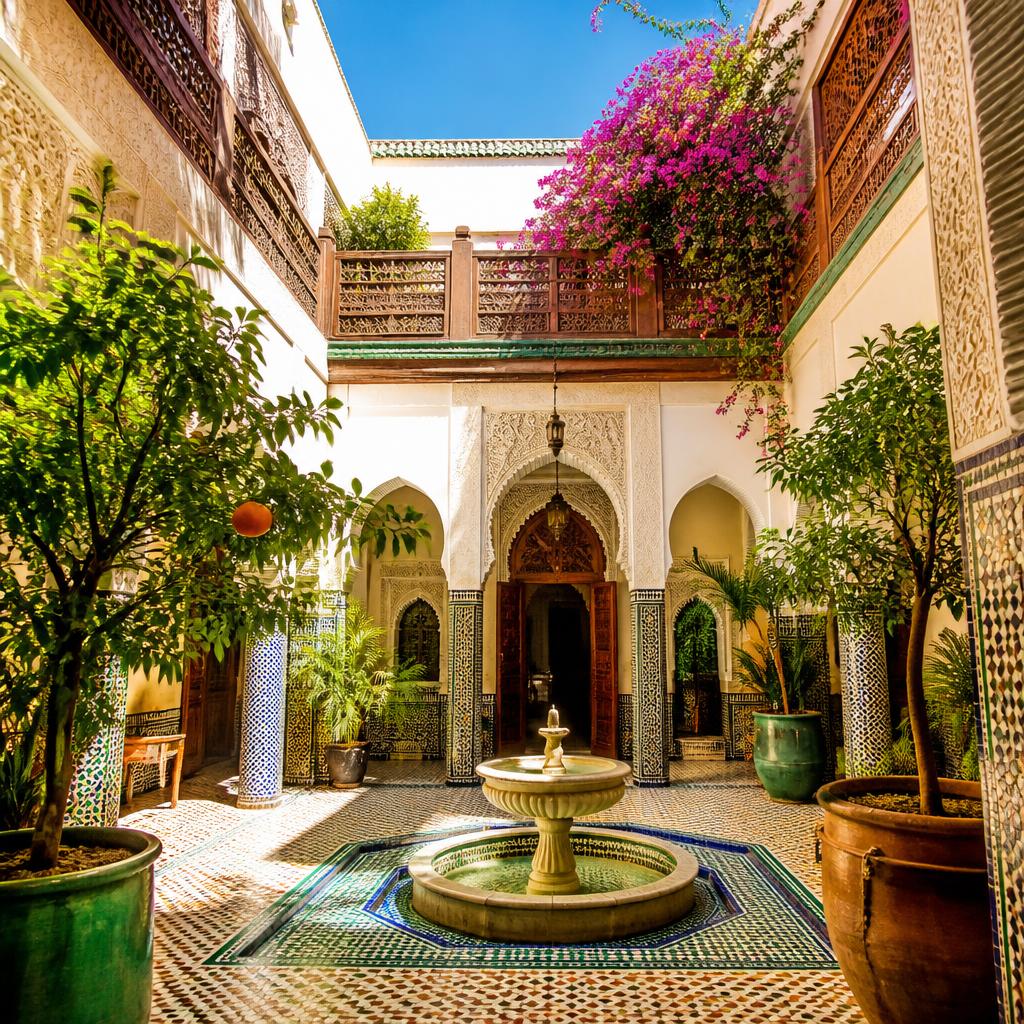
Marrakech — the Medina and the Atlas Mountains

Morocco, North Africa · Imperial City

Marrakech

Royal Mansour's private riad city within the medina walls, La Mamounia's legendary gardens, and the Djemaa el-Fna as the sun drops behind the Koutoubia. Morocco's great seduction.

No need to read on

Skip ahead — plan your Marrakech escape now.

Tell us your dates and your pace. Personalised suggestions, never confirmed reservations.

Plan My Escape — £19.99

The Case for Going

Three hours from London, a UNESCO medina that has not changed its essential character in five centuries.

Marrakech is the most accessible of the world's great imperial cities — three hours from London, no visa, and an arrival experience (the Djemaa el-Fna square at dusk, when the snake charmers and the Gnawa musicians and the food-stall smoke and the muezzin from the Koutoubia all combine) that no other city on earth replicates at any distance. The UNESCO-listed medina, founded in 1070 by the Almoravid dynasty, is the most intact medieval Arab city in North Africa: a labyrinth of souks organised by trade guild, hammams in continuous operation, and a residential fabric of courtyard houses behind blank street facades that conceals some of the finest craftsmanship in the Islamic world.

The luxury infrastructure in Marrakech is the most concentrated in Africa: Royal Mansour (commissioned by the King of Morocco), La Mamounia (the most famous hotel on the continent), Amanjena (Aman's first African property), and dozens of smaller riads converted by French, British, and Moroccan aesthetes into boutique hotels of genuine quality. The combination — one of the world's great historic cities with a luxury hotel infrastructure of international standing — makes Marrakech the most compelling short-haul destination available to the UK luxury traveller.

The Atlas Mountains are two hours south; the Sahara four. Marrakech works as a destination in its own right (four nights, the medina and the palmeraie) or as the gateway to the most extraordinary road trip in Africa.

The Destination at a Glance

An imperial Moroccan city 3 hours from London: medina souks, Atlas views, and the most accomplished riad hotel culture in Africa.

Marrakech is Morocco's fourth imperial city (after Fez, Meknès, and Rabat) and the most visited destination in Africa. Marrakech Menara Airport (RAK) receives multiple daily direct flights from London Heathrow (British Airways), Gatwick (easyJet), and Stansted (easyJet, Ryanair); the 3–3.5-hour flight time makes it viable for long weekends. The city is organised in three zones: the UNESCO medina (the old city within the 19-kilometre medieval walls), the Ville Nouvelle (the French colonial city of the 1920s, now home to galleries and restaurants), and the palmeraie (the 13,000-hectare palm grove north-east of the city where several of the largest resort hotels are located).

The Marrakech climate is semi-arid: hot, dry summers (June–August, up to 42°C) and mild winters (December–February, 8–20°C). The best visiting windows are spring (March–May) and autumn (September–November) when daytime temperatures of 22–28°C are comfortable for medina walking. The Atlas Mountains are visible from the medina and from the palmeraie on clear winter and spring mornings, a backdrop of snow-capped peaks behind the rose-red city walls.

Best Time to Visit

When to go.

Mar – May

Spring

The most beautiful Marrakech season: rose gardens in bloom, Atlas snow still visible, 22–26°C. The light is exceptional for photography. Blossom in the palmeraie. Jacaranda in the Ville Nouvelle.

Sep – Nov

Autumn

Temperatures dropping from summer extreme. October is ideal: 25–30°C, low humidity, the medina at its most atmospheric. The date harvest in the palmeraie (October). Excellent for Atlas and Sahara extension.

Our Pick

October

The date harvest coincides with perfect temperatures and the year's best light. The medina is uncrowded compared to March. The Atlas is accessible. The most complete Marrakech month in every dimension.

Where to Stay

Five worth knowing.

01

Royal Mansour Marrakech

Medina

Commissioned by King Mohammed VI and opened in 2010, Royal Mansour occupies a full hectare within the walls of Marrakech's medina — a private city within a city, comprising fifty-three individual riads connected by a network of subterranean service tunnels so that guests never see staff movement in the courtyard. Each riad (three floors, private courtyard, plunge pool, and terrace) is the most space-generous accommodation in Marrakech; the design, by Moroccan master craftsmen over six years, is the highest expression of Moroccan decorative arts — zellij tilework, carved plaster mashrabiya, cedarwood ceilings.

Best for

Couples who want the most architecturally significant and culturally authentic luxury hotel in Marrakech — the Royal Mansour's riad structure and medina position are without equivalent in Morocco.

02

La Mamounia

Medina, Bab Jdid

The most famous hotel in Morocco, La Mamounia has occupied the same position within the medina walls since 1923 — originally the wedding gift of a sultan to his son, later a palace hotel that sheltered Winston Churchill, Alfred Hitchcock, and the Rolling Stones. The 2009 refurbishment by Patrick Jouin and Sanjit Manku preserved the Moorish-Art Deco hybrid architecture while adding a spa of 2,500 square metres beneath the olive and orange gardens. The gardens — a private twelve-hectare park within the medina — are the finest hotel grounds in Marrakech.

Best for

Couples who want the legendary name and the largest private gardens in the medina, plus the most famous bar in Morocco (the Churchill Bar) and a spa that justifies a standalone visit.

03

Amanjena

Palmeraie

Aman's first African property — forty pavilions and maisons arranged around a twelve-metre pink bassin south of Marrakech on the road to the Atlas Mountains. Aman Marrakech — opened in 2000 as Amanjena, the Peaceful Paradise — is the most private of the major palmeraie properties: low-slung pavilions of rose-red pisé (rammed earth) around private courtyard gardens, with the Atlas visible on clear mornings and a silence unusual for a hotel twelve kilometres from the Djemaa el-Fna. The restaurant, constructed around the bassin, is Marrakech's most theatrical dinner setting.

Best for

Couples who want the Aman sensibility in Morocco — the silence, the space, the personal service — with the Atlas views that the medina properties cannot offer.

04

Dar Ahlam

Skoura Oasis, Draa Valley

Not in Marrakech itself but three hours south through the Tizi n'Tichka pass and into the Draa Valley — Dar Ahlam is the most celebrated kasbah hotel in the Moroccan desert, a restored 17th-century fortress in the Skoura palmery with twelve rooms and suites. The house model (no menu, no schedule, everything improvised around your preferences) is the most refined expression of Moroccan hospitality in the country; the landscape (the Draa Valley's palmery, the Sahara beyond, and the silence of a genuine palmery oasis at night) is unrepeatable. Best combined with two nights in Marrakech before driving south.

Best for

Couples who want to extend Marrakech into a Moroccan circuit — the Draa Valley and the Sahara edge combined with Marrakech's medina culture is the most complete Morocco itinerary.

05

Riad Farnatchi

Northern Medina

A boutique riad of seven suites in Marrakech's northern medina, in the quarter north of the main souk that is less frequented by day-trippers than the Djemaa el-Fna area. Riad Farnatchi's five original houses have been merged into a single property with a roof terrace of extraordinary quality (the views north over the medina roofscape towards the Koutoubia minaret are the best available from a private terrace) and a small pool in the central courtyard. The breakfast — served in the courtyard or on the roof — is the most accomplished in Marrakech's riad sector.

Best for

Couples who want the authentic medina riad experience on a boutique scale — the northern medina location removes you from the tourist circuit while keeping you within walking distance of the Mouassine Fountain and the finest Marrakech souks.

Souks, Palaces & Hammams

What to do.

Djemaa el-Fna at dusk

Marrakech's central square — a UNESCO Intangible Cultural Heritage designation, the first such designation anywhere in the world — is a different city at different hours. At noon it is a marketplace; at dusk it transforms into the largest outdoor theatre on earth: 600-year-old storytelling circles, Gnawa musicians (the Sufi sub-Saharan trance musicians whose culture was brought north along the trans-Saharan trading routes), henna artists, juice sellers, and the smoke from 200 food stalls rising into the North African evening sky. The rooftop of Café Argana (north-east corner of the square) or Café de France (directly above the square) are the correct vantage points for the first evening; once you understand the geography, walk into the square on foot.

The major palaces

The Bahia Palace (19th century, 8 hectares, 160 rooms of extraordinary zellij and plaster carving — built by Ba Ahmed, Grand Vizier to Sultan Hassan I, as a palace for his 4 wives and 24 concubines) and the ruined Palais El Badi (16th century, commissioned by Sultan Ahmed al-Mansour with the ransom gold from the Battle of the Three Kings) are the two essential Marrakech monuments after the Koutoubia Mosque. The Saadian Tombs — sealed by the Alawite Sultan Moulay Ismail in 1672 and not rediscovered until aerial photography revealed them in 1917 — contain the mausoleums of the Saadian dynasty in a state of preservation extraordinary for a site sealed for 250 years.

Hammam Dar el-Bacha

The hammam (traditional bathhouse) attached to the Dar el-Bacha palace in the northern medina is one of the few historic neighbourhood hammams in Marrakech that admits tourists alongside local residents, now as part of the Musée des Confluences complex. The hammam experience — steam room, kessa scrub, savon beldi application, cold rinse — takes ninety minutes and is the most culturally specific physical experience that Marrakech offers. The hammams at Royal Mansour and La Mamounia are the most refined hotel versions; Hammam de la Rose in the medina offers a high-quality tourist-focused version with private rooms and English-speaking attendants.

Souk immersion

The Marrakech souks are organised by trade in a system that has been geographically stable since the 11th century: the souk des teinturiers (dyers, where skeins of wool are hung above the alleys in saffron and crimson and turquoise); the souk Cherratin (leather workers, where belts and babouches are hand-stitched on lasts unchanged for centuries); the souk Haddadine (metalworkers, where lanterns and mirrors are hammered at the anvil); and the Criée Berbère (the old slave auction market, now the carpet souk, where Berber merchants display Atlas kilims). A two-hour guided introduction with your hotel's recommended guide provides the contextual map; the rest is independent immersion.

What to Eat and Drink

Pastilla pigeon, preserved lemon tagine, and mint tea poured from height.

Moroccan cooking is the most complex in North Africa: the accumulated influence of Berber, Arab, Andalusian, and Jewish culinary traditions, expressed through a spice palette of extraordinary depth (ras el hanout at its finest contains 27 spices). The pastilla — a warqa pastry parcel of pigeon or chicken, almonds, cinnamon, and egg, dusted with icing sugar — is Moroccan cooking's most baroque production: sweet and savoury simultaneously, texturally contradictory, and historically rooted in the Andalusian cooking of Moorish Spain. Nomad restaurant (Derb Aarjane, rooftop, contemporary Moroccan) serves the most accomplished version in Marrakech.

The preserved lemon and olive chicken tagine (djej chermoula) is the most ubiquitous Moroccan main course and also the hardest to execute at the level of the best medina restaurants: the lemon's salinity against the olive's bitterness against the saffron-tinged chicken broth is a balance that requires cooking time and technique. Dar Yacout and La Maison Arabe are the traditional high-end versions; the Djemaa el-Fna stalls (particularly stall 14 and 32) offer an unrefined but genuine version that the best restaurants aspire to. Mint tea (the Moroccan hospitality gesture, poured from height to create foam) is non-negotiable; alcohol is available only at hotels and licensed restaurants.

The Bespoke Horizons View

The most remarkable three-hour journey from London.

Marrakech has been oversold and under-experienced by the European short-break market — the tendency to stay inside the riad and use the medina as backdrop rather than subject is a wasted opportunity. The city rewards immersion: get lost in the souks without a map on day two, find the hammam with actual local customers, eat at the Djemaa el-Fna stalls rather than the tourist restaurants facing the square.

The Royal Mansour is the correct answer for most couples seeking luxury without compromise — the individual riad structure gives you a private house within the medina walls, which is the most specific luxury Marrakech offers. Four nights there (two medina days, one palmeraie day, one Atlas day trip) is our standard recommendation. For those extending into the Draa Valley and the Sahara, Dar Ahlam in the Skoura oasis adds the dimension that makes Morocco the most complete country on the continent.

The Koutoubia at Fajr prayer, the medina still dark and cool, the smell of bread from the public ovens. Marrakech before anyone else is awake. The city at its most itself.

Essential Information

The practical detail.

Currency
Moroccan Dirham (MAD); exchanged at hotels or on arrival at airport bureaux de change
Language
Darija (Moroccan Arabic) and French; English spoken at all hotels, French useful in the medina
Flights from UK
3–3.5 hours direct from London (Heathrow, Gatwick, Stansted); easyJet, British Airways, Royal Air Maroc daily
Time zone
GMT +1 (Western European Time; Morocco does not observe BST)
Visa
No visa required for UK passport holders; valid passport sufficient
Dress code
Modest dress in the medina — covered shoulders and knees for both men and women; hotel pools are fully relaxed; alcohol available at hotels and licensed restaurants only
Bargaining
Expected in the souks; starting price is typically 3–4x the expected final price; agree only what you are prepared to pay
Budget range
£400–£3,000+ per room per night at Royal Mansour (individual riads); boutique riads from £150

Frequently Asked

Questions, considered.

Plan Your Marrakech Escape

Your personalised Marrakech itinerary, in your inbox within minutes.

Royal Mansour or La Mamounia for the medina, Amanjena for the palmeraie, and a curated souk programme with a licensed guide — the Marrakech itinerary that rewards engagement rather than observation.

Bespoke Horizons provides personalised travel planning and itinerary suggestions. We are not a booking agent and all recommendations are non-binding.

Ready to plan your Marrakech escape?

Plan My Escape — £19.99