Mallorca — limestone cliffs above turquoise Mediterranean coves

Balearic Islands, Spain · Mediterranean Escape

Mallorca

The Mediterranean island that rewards those who look beyond the brochure.

No need to read on

Skip ahead — plan your Mallorca escape now.

Tell us your dates and your pace. Personalised suggestions, never confirmed reservations.

Plan My Escape — £19.99

The Case for Going

The Balearic that kept its secret longest.

Mallorca suffers, if suffering is the word, from its own success. The island receives more than thirteen million visitors a year, which is enough to have convinced a generation of European travellers that it is a resort destination rather than a travel one. This is an error. The Mallorca that exists beyond the southern hotel strips — the Serra de Tramuntana, the artist's village of Deià, the limestone cove coast of the south-east, the baroque quarter of Palma — is one of the most accomplished luxury destinations in the Mediterranean, and it has the additional advantage of being genuinely underestimated by the travellers who know Santorini and Amalfi by heart.

The Serra de Tramuntana — a UNESCO World Heritage mountain range that runs along the island's north-west coast for 90 kilometres, dropping directly to the sea — is the landscape that defines the island's upper register. Robert Graves lived in Deià for most of his adult life and is buried there. Frédéric Chopin spent a winter in a Valldemossa monastery. The light that drew them both still draws painters, architects, and the kind of traveller who wants a hotel in a 16th-century manor house with olive groves on three sides and the sound of goat bells at dusk.

For couples, Mallorca offers a range of experience that few islands in Europe can match. The cliff-top fortress hotel, the mountain village manor, the boutique in Palma's Gothic quarter, the private boat to a cove that has no road leading to it — the island is large enough to contain multitudes, small enough that the best of it is always within an hour's drive. And between May and June, and again in September, it manages the rare trick of being both warm enough for the sea and quiet enough to feel like your own discovery.

The Destination at a Glance

An island of dramatic contrasts — mountain, sea, and city within an hour's reach of each other.

Mallorca is the largest of the Balearic Islands, at 3,640 square kilometres roughly the size of Majorca. It sits in the western Mediterranean, 200 kilometres south-east of Barcelona and 170 kilometres from Valencia. The island divides into three distinct geographies: the Serra de Tramuntana on the north-west (rugged, mountainous, UNESCO-listed, the island's most dramatic scenery), the central plain of Es Pla (agricultural, quiet, the place for olive estates and almond groves), and the limestone cove coast of the south-east (the turquoise-water destination, the Cala Mondragó and Caló des Moro terrain that appears on every photograph of the island at its most beautiful).

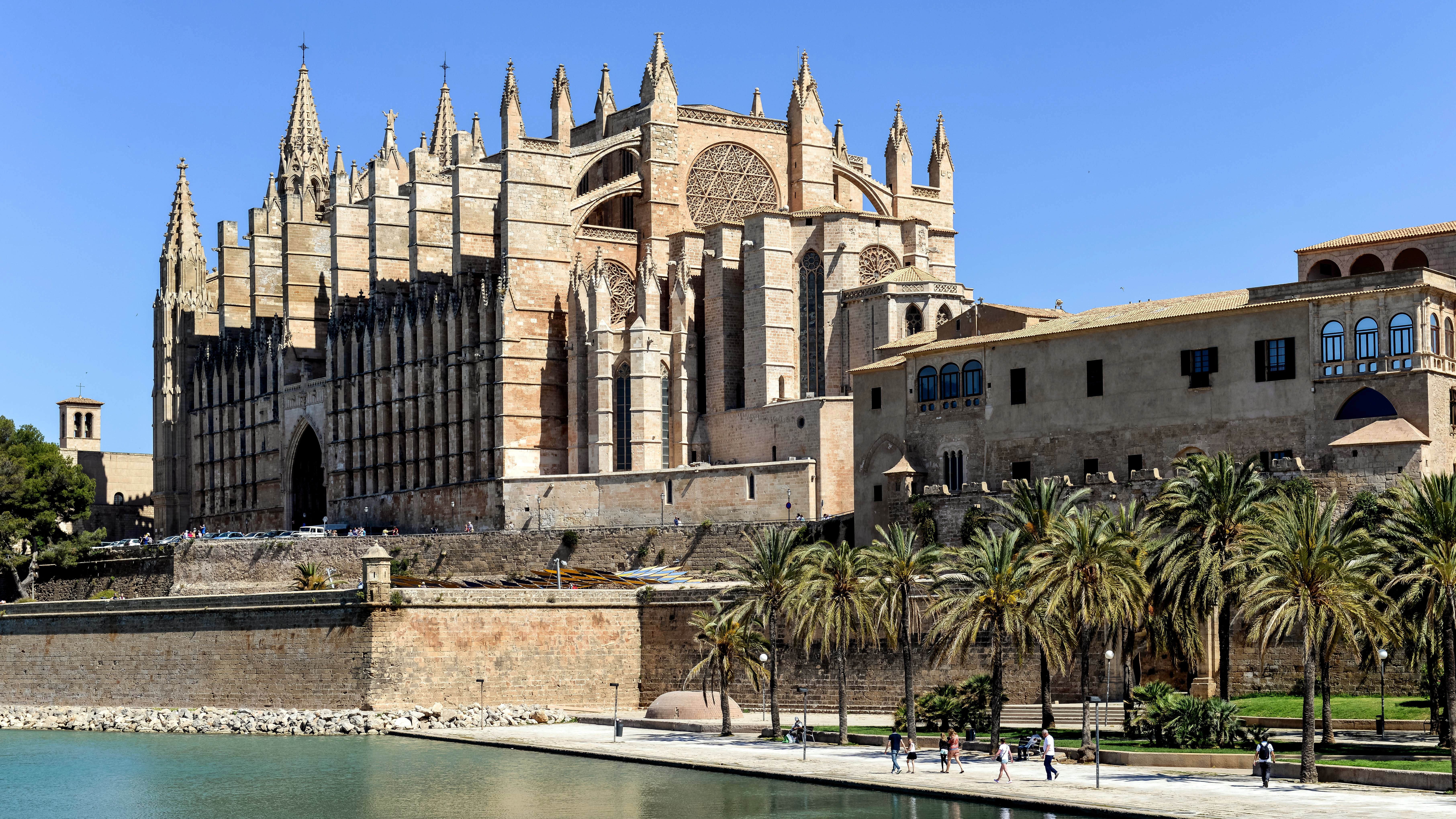
Palma, the capital (population 400,000), is one of the most accomplished cities in the western Mediterranean: a Gothic cathedral of extraordinary scale built directly on the seafront, a maze of Renaissance and Art Nouveau architecture behind it, and a restaurant scene in the Casc Antic (the old quarter) that now holds more Michelin stars than the rest of the Balearics combined. It is the city that Ibiza does not have and Menorca cannot replicate.

Flights from the UK take 2 to 2.5 hours — direct services operate from most major UK airports, with British Airways and Jet2 providing the most reliable year-round schedules. Palma's Son Sant Joan Airport is well served and easy to navigate; a private transfer to the Tramuntana takes 45 minutes, to the south-east coast around 90 minutes. Car hire is essential — the island's best areas are distributed across terrain where a vehicle changes everything.
Best Time to Visit

When to go.

May — Jun

Our Pick

The island at its most beautiful — wildflowers in the Tramuntana, the almond harvest done, the sea warm enough to swim (20–22°C), and the August crowds still two months away. The hotel season is fully open; the restaurants are attentive. This is the Mallorca that deserves its reputation.

September

Shoulder

The sea at its warmest (26°C), the August crowds departed, and a quality of light in the Tramuntana that the summer months do not match. Rates soften noticeably after the first week. October is still excellent, though some smaller restaurants begin to close from mid-month.

Jul — Aug

Peak

Hot, crowded, and expensive. The popular coves become gridlocked by 10:00 and inaccessible by road by 11:00. If you must travel in peak season, a private boat charter becomes non-negotiable, and the hotel itself becomes the primary destination.

Where to Stay

Five worth knowing.

The hotels that define Mallorca at its finest — from fortress conversions to mountain manor houses. Suggestions, never confirmed reservations.

01

Jumeirah Port Soller

Port de Sóller, north-west coast

Carved into the cliff above the natural harbour of Port de Sóller, where the Serra de Tramuntana meets the sea. One hundred and twenty rooms and suites arranged on terraced levels descending to the Mediterranean, two infinity pools suspended above the water, and a spa that looks directly at the tram that has been running between Sóller and Palma since 1912. The most dramatically positioned hotel in the Balearics.

Best for

Couples who want a full-service luxury hotel in the island's most beautiful natural setting — the mountain-meets-sea location at Port de Sóller is unique in the Mediterranean.

02

Belmond La Residencia

Deià, Serra de Tramuntana

Two 16th-century manor houses joined by gardens in the artist's village of Deià — a village of 700 people in the Tramuntana mountains where Robert Graves lived for decades and where the light has been attracting painters since the 1930s. Sixty-seven rooms and suites, a spa built into the hillside, and El Olivo restaurant in a converted olive mill with the best kitchen in the mountains. Adults-leaning throughout.

Best for

Couples who want the most storied and most culturally layered luxury hotel in Mallorca — the Deià setting, the art collection, and the mountain light make this irreplaceable.

03

Cap Rocat

Cala Blava, near Palma

A 19th-century military fortress on a private peninsula 15 minutes from Palma Airport, restored to a 30-room hotel of extraordinary restraint. The rooms are carved into the ramparts; the pool is cut into the limestone above the sea; the access road is private and the landmass entirely so. Breakfast is served in the old armaments room. There is nothing quite like it in European hotel accommodation.

Best for

Couples for whom absolute privacy and architectural distinction are the primary requirements — Cap Rocat's fortress position and seclusion are without parallel in the western Mediterranean.

04

Hotel Sant Francesc

Palma old quarter

A converted 19th-century mansion in Palma's historic centre — 42 rooms set around a Renaissance courtyard, a rooftop pool with views over the Palma skyline to the sea, and a position that puts you 400 metres from the Cathedral and in the heart of the city's best restaurants. The most refined boutique hotel address in the Mallorcan capital, and the right base for a couple who wants urban luxury alongside the island.

Best for

Couples who want Palma as their primary experience — the old quarter, the restaurants, the Cathedral — with easy access to the island's coast and mountains.

05

Son Brull

Near Pollença, north Mallorca

An 18th-century Jesuit monastery in the farming country south of Pollença, converted to a 23-room hotel with an exceptional spa, an organic kitchen garden that supplies the restaurant directly, and a position that gives access to the north of the island — Cap Formentor, the Formentor beach, and the Pollença old town — without sacrificing the seclusion of the agricultural interior. Adults-only.

Best for

Couples who want adults-only seclusion in the north of the island, with a serious spa programme and the most genuine farm-to-table cooking of any Mallorcan luxury hotel.

Beyond the Pool

What to do.

An island of genuine variety — mountain, sea, city, and vineyard, all within reach.

The Tramuntana drive

The MA-10 coast road from Andratx to Pollença — 100 kilometres of cliff-edge driving through the UNESCO mountain range, past the villages of Banyalbufar, Valldemossa, Deià, Sóller, and Pollença. The best drive in the western Mediterranean, and the definitive Mallorcan experience for a couple in a hire car on a clear morning. Allow a full day; stop for lunch in Deià at Ca's Patró March, accessible only by the path from the village to the cala below.

Private boat to the hidden coves

The south-east coast's limestone coves — Caló des Moro, Cala Llombards, Cala S'Almunia — are reachable by road but inaccessible in any meaningful sense in summer without arriving at dawn. A private day boat from Porto Petro or Colònia de Sant Jordi gives unrestricted access: anchor in the cove, swim in water of extraordinary clarity, move on when you choose. The charter boats available from the south coast hotels are the correct answer to the cove question.

Palma old quarter

La Seu, the Gothic cathedral begun in 1229 and not completed for 350 years, stands directly on the waterfront at a scale that surprises even those who have seen it in photographs. Gaudí spent time here working on the interior — the canopy above the altar is his. The streets behind it — the Casc Antic, the Calatrava barrio, the Sant Francesc square — contain the best concentration of Renaissance architecture in any Spanish city outside Salamanca, and the restaurant scene has caught up to match it.

Wine tasting in the island's vineyards

Mallorca's wine industry has undergone a serious revival over the past two decades. The Binissalem DO in the central plain (Bodegas José L. Ferrer, Macià Batle) produces reds from the indigenous Mantonegro grape with a structural quality that the Spanish mainland is only beginning to acknowledge. Pla i Llevant on the eastern plateau produces more complex whites. A half-day tour of two estates, with a serious tasting and a lunch of pa amb oli with Mallorcan charcuterie, is the correct afternoon in the island's interior.

What to Eat and Drink

A cuisine older than tourism, and a Palma restaurant scene catching up to the island's ambition.

Mallorcan cuisine is built on a handful of foundational ingredients: sobrassada (the raw cured sausage seasoned with sweet paprika, spread on bread still warm from the wood oven), pa amb oli (the canonical Mallorcan meal — bread rubbed with tomato and olive oil, topped with whatever the kitchen offers), tumbet (the layered potato, aubergine, and tomato gratin that appears on every traditional menu), and the ensaïmada, the spiral pastry that has been made in Mallorca since the 17th century and is still the correct breakfast at 08:00 in any village café.

Palma's restaurant scene has been transformed in the past decade. Marc Fosh's eponymous restaurant in the Convent de la Missió hotel (the first Michelin star in the Balearics, held continuously since 2009) remains the most accomplished kitchen on the island — modern Mediterranean cooking using Mallorcan producers with a restraint that the island's natural abundance makes easier than it looks. Adrián Quetglas in the Casc Antic is the more contemporary choice, with a tasting menu that leans into the island's Arabic culinary inheritance. For something more immediate: the restaurant at Belmond La Residencia's El Olivo in Deià uses vegetables from the hotel garden and changes with what the Tramuntana produces each week.

The local wine to drink is Mantonegro — the indigenous red grape of the Binissalem DO, producing structured, moderately tannic wines that pair precisely with the island's charcuterie and lamb. At Belmond La Residencia and Son Brull, the house selection leans heavily local; the sommeliers know the estate wines personally. At Cap Rocat, the cellar extends to the broader Spanish canon with a depth that rewards those who ask.

The Bespoke Horizons View

The island that keeps being underestimated — and keeps rewarding those who look properly.

The couples who book Mallorca with us tend to arrive expecting a competent Mediterranean week and leave with a destination they actively want to return to. The island consistently delivers more than its reputation promises — the Tramuntana is genuinely among the great European landscapes, Palma is genuinely among the great small European cities, and the quality of the best hotels (Belmond La Residencia, Cap Rocat, Jumeirah Port Soller) is genuinely among the finest in the Mediterranean basin.

The critical variables are timing and geography. Mallorca in August, in the resort towns of the south coast, is a different experience from Mallorca in June, in the mountains above Deià. We build itineraries that treat the island as the sophisticated destination it is: one base in the Tramuntana or the Palma old quarter, a private boat day for the south-east coves, the MA-10 drive in one direction, and time in the city at the beginning or the end.

A week in Mallorca, properly arranged, is not a consolation for being unable to get to Santorini. It is a different — and in several respects superior — proposition entirely.

Essential Information

The practical detail.

Currency
Euro (€); cards accepted universally
Language
Spanish and Catalan (Mallorquí); English widely spoken in tourist areas
Flights from UK
2–2.5 hours direct from most UK airports (Jet2, easyJet, British Airways, TUI)
Time zone
GMT +1 (GMT +2 in summer)
Visa
No visa required for UK passport holders (90-day Schengen allowance)
Getting around
Car hire essential — the island's best areas are spread across a rugged terrain
Tipping
Not obligatory; 10% appreciated at restaurants for good service
Budget range
£300–£1,500+ per person per night at the island's finest luxury properties

Frequently Asked

Questions, considered.

Plan Your Mallorca Escape

Your personalised Mallorca itinerary, in your inbox within minutes.

The right hotel for your priorities — Tramuntana manor, Palma boutique, or clifftop fortress — alongside the MA-10 drive, a private boat day on the south-east coves, the Palma restaurants worth reserving in advance, and the vineyard that repays the detour. The Mallorca that rewards those who plan properly.

Bespoke Horizons provides personalised travel planning and itinerary suggestions. We are not a booking agent and all recommendations are non-binding. Hotel availability, pricing, and adults-only policies are subject to change — we recommend verifying current details directly with properties before booking.

Ready to plan your Mallorca escape?

Plan My Escape — £19.99