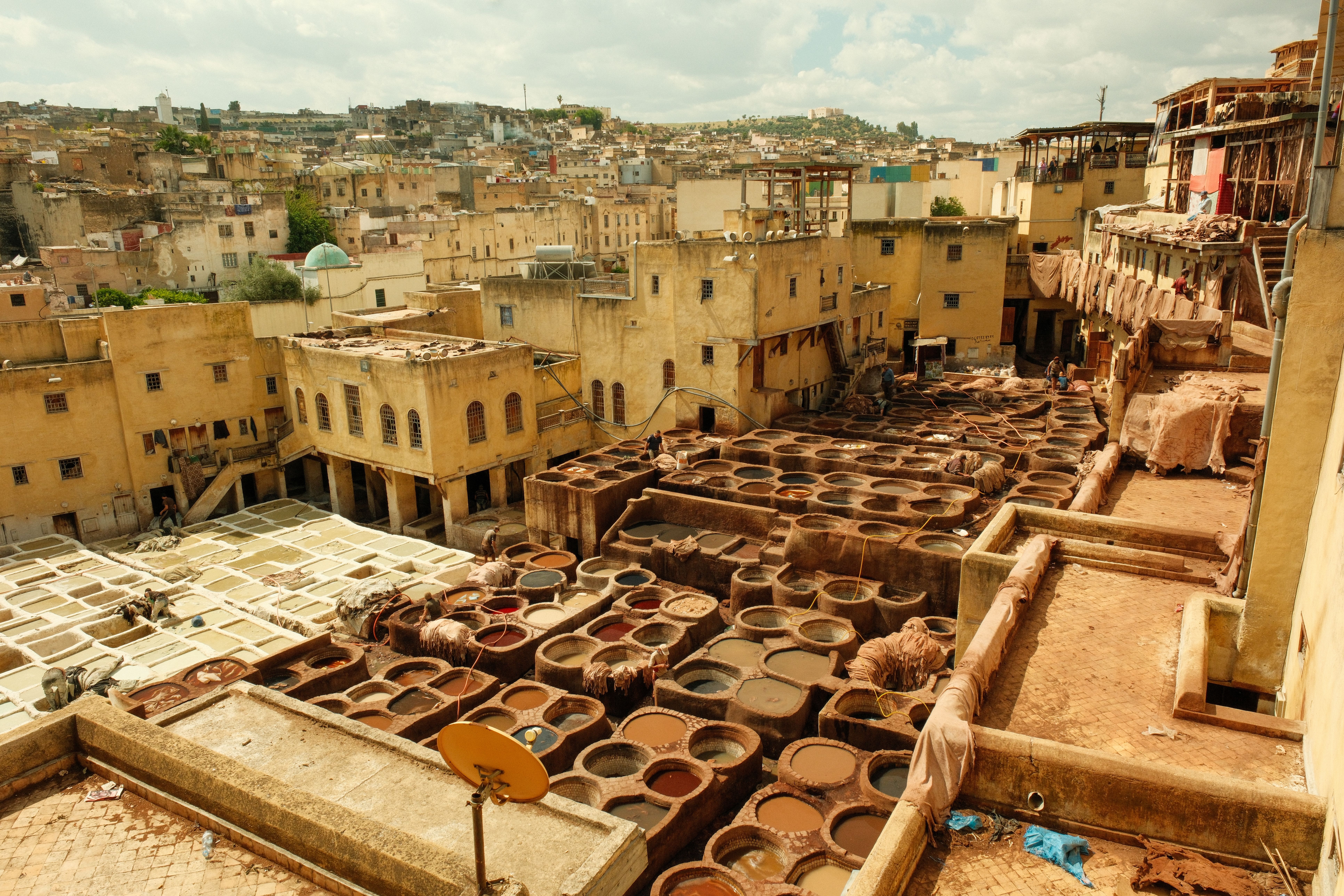
Fez — the Chouara tanneries and the UNESCO medina roofscape

Morocco, North Africa · Imperial City & Medieval Medina

Fez

The world's oldest university, the largest car-free urban area on earth, and the Chouara tanneries in the morning light — the same saffron and indigo vats that have been dyeing leather since the 11th century. Morocco's uncompromised soul.

No need to read on

Skip ahead — plan your Fez escape now.

Tell us your dates and your pace. Personalised suggestions, never confirmed reservations.

Plan My Escape — £19.99

The Case for Going

The most completely preserved medieval Arab city on earth, where 150,000 people still live within the walls the Marinid dynasty built in the 13th century.

Fez el-Bali (Old Fez, the UNESCO-listed medina) is the most completely preserved medieval Arab city on earth: 9,400 streets, 9 gates, 350 mosques, and a functioning craft economy (the tanneries, the potters' quarter, the weavers, the metalworkers, the woodcarvers) that has been in continuous operation since the Marinid dynasty's construction programme in the 13th and 14th centuries. The medina is the world's largest car-free urban area — not by policy but by geometry: the streets are too narrow for vehicles, and goods are transported by donkey as they have been for eight centuries.

The Qarawiyyin University (founded 859 CE by Fatima al-Fihri, the world's oldest continuously operating educational institution), the Bou Inania Madrasa (the most accomplished example of Marinid decorative arts, accessible to non-Muslims), and the Nejjarine Fountain (the most beautiful public space in Fez, the cedarwood caravanserai above it now a museum of Moroccan wooden crafts) together form an educational and architectural sequence that no other Moroccan city approaches.

Fez is harder to navigate than Marrakech, less immediately theatrical than the Djemaa el-Fna, and requires more surrender to disorientation. It rewards this with a depth that Marrakech's tourist circuit cannot provide — the conviction that you are not being shown a curated version of Morocco but are present in an actually existing medieval city that happens to allow visitors.

The Destination at a Glance

Morocco's second city and first imperial capital: Fez el-Bali (the old medina, UNESCO), Fez el-Jdid (the 13th-century new city), and Ville Nouvelle (the French colonial city).

Fez-Saïs Airport (FEZ) is 15 kilometres from the medina and receives direct flights from London on EasyJet (Luton) and Ryanair (Stansted), plus connections via Casablanca on Royal Air Maroc. The three-hour flight time from London is the same as Marrakech; the connection through Casablanca is unnecessary for most UK travellers. The taxi from the airport to the medina riads (approximately MAD 150–200, fixed price from the official taxi rank) takes 20 minutes.

The medina of Fez el-Bali is physically larger than the entirety of some European cities: a UNESCO World Heritage area of 280 hectares with a resident population of 150,000, making it both the largest and the most densely inhabited medieval urban fabric in the world. The city's three zones — Fez el-Bali (the oldest, pre-9th century), Fez el-Jdid (the 'New Fez' of the Marinid dynasty, 13th century, where the Royal Palace is located), and the Ville Nouvelle (the 1920s French colonial city) — are each distinct in character and each accessible from the others on foot or by petit taxi.

Best Time to Visit

When to go.

Mar – May

Spring

The finest Fez season: rose and orange blossom in the riad courtyards, 20–26°C, and the tanneries at their most colourful as the dye concentrations are freshest after winter replenishment. The Fez Festival of World Sacred Music occurs in late May.

Sep – Nov

Autumn

The summer heat declining from peak (July–August can reach 38°C). October is ideal: 22–28°C, the medina's tourist crowds thin, and the Middle Atlas mountains behind Fez turning colour.

Our Pick

April

Spring at its most complete: 23–27°C, riad garden flowers at peak, the light on the zellij tilework at the Bou Inania best between 09:00–11:00 in April. The Fez spring is the most sensory season in Morocco.

Where to Stay

Five worth knowing.

01

Palais Faraj Suites & Spa

Fez el-Bali, UNESCO Medina

Twenty suites in a restored 19th-century palace at the edge of the Fez el-Jdid (New Fez) quarter, with arguably the finest panoramic view of the Fez medina available from any hotel property: the terrace restaurant looks west across the full extent of the medina below, with the Bou Inania Madrasa's minaret, the Chouara tanneries' coloured vats, and the Andalusian quarter's roofscape all visible simultaneously. The palace's restoration (zellij, plaster carving, carved cedarwood) is among the most accomplished in Fez; the spa — a hammam of traditional design in the palace basement — is the finest in the medina.

Best for

Couples who want the single best view of Fez's medina from a hotel property combined with a traditional hammam in a restored palace — the Palais Faraj view is the panorama that other hotels provide only at terrace bars.

02

Riad Fès

Fez el-Bali, Northern Medina

Twenty rooms in three interconnected riads in the northern medina — the most awarded boutique hotel in Fez, a Relais & Châteaux member since 2009. The Riad Fès's courtyard (marble, carved plaster, fountain, and a central lemon tree that has been growing since the riad's first life as a merchant's house in the 18th century) is the most frequently photographed interior in Fez; the restaurant (Moroccan cooking at its highest level — Fez is considered the culinary capital of Morocco, where the Court cooking of the medieval Marinid dynasty was codified) is consistently the most accomplished in the medina.

Best for

Couples who want the most celebrated boutique riad experience in Fez — the Relais & Châteaux standard, the 18th-century courtyard, and the most acclaimed medina restaurant.

03

Dar Roumana

Andalusian Quarter, Fez el-Bali

Six rooms in a boutique riad in the Andalusian quarter — the quieter, less-touristed east bank of the Fez River, separated from the main souk circuit by the Qarawiyyin mosque. Dar Roumana (the pomegranate house, named for the trees in the central courtyard) was restored by Vincent and Jennifer Berger in 2006; the restaurant (the table d'hôte dinner, served to all guests simultaneously in the courtyard and cooked by Jennifer, is the most personal dining experience available in a Fez riad) and the six rooms' extraordinary quiet (the Andalusian quarter has fewer pedestrians and no motorbike traffic) make it the most intimate riad in the medina.

Best for

Couples who want the most intimate Fez riad — six rooms, a personal chef's table dinner in the courtyard, and the quiet of the Andalusian quarter away from the souk circuit.

04

Riad Laaroussa

Fez el-Bali, near Bou Inania Madrasa

Seven rooms in a 17th-century riad in the oldest quarter of Fez el-Bali, 200 metres from the Bou Inania Madrasa and a five-minute walk from the Chouara tanneries. Laaroussa's distinguishing characteristic is its private hammam programme — guests book one of three private hammam suites (each with its own plunge pool and kessa attendant) for a two-hour session that is the most thoroughly traditional hammam experience in Fez; the Moroccan soap, black mud, and argan oil treatments are conducted by Fassi women trained in the traditional methods of the Fez hammam culture, which is distinct from the hammam cultures of Marrakech and the coastal cities.

Best for

Couples who want the most accomplished private hammam experience in Fez — Laaroussa's hammam suites and Fassi-trained attendants provide the most traditional medina bathing culture available to visitors.

05

Palais Amani

Fez el-Bali, Fez River quarter

Fourteen rooms in a 14th-century palace on the banks of the Fez River — the most historically resonant address in a city of historical addresses. The Palais Amani's position (the palace was built during the Marinid dynasty that also built the Bou Inania Madrasa and commissioned the expansion of the Qarawiyyin University) gives the building a historical significance unusual even by Fez standards; the restoration (completed 2009) preserved the original tiled floor patterns and stucco work while adding contemporary amenity. The rooftop pool — the only pool in the medina from which the Bou Inania minaret is visible — is the most photographed hotel exterior in Fez.

Best for

Couples who want the most historically significant palace in the Fez medina — the Amani's 14th-century Marinid provenance and the rooftop pool with the Bou Inania view are without equivalent.

Tanneries, Madrasas & Crafts

What to do.

Chouara Tannery

The Chouara Tannery in the northern medina is the oldest and largest of Fez's three working tanneries — an 11th-century stone bowl complex of circular dyeing vats arranged in a honeycomb pattern on the riverbank, visible from the terraces of the surrounding leather goods shops. The tanning process is unchanged since the Marinid period: hides are soaked in pigeon dung (the ammonia loosens the hair), then transferred to vats of natural dye — saffron (yellow), poppy (red), indigo (blue), henna (orange), pomegranate (black), and cedar (brown) — and beaten and kneaded until the colour penetrates. The pungency of the process is considerable; the terrace views above provide mint sprigs as an olfactory counterpoint. The best light on the vats is between 09:00 and 11:00 on sunny mornings.

Bou Inania Madrasa

The Bou Inania Madrasa (1350–1357, Marinid Sultan Bou Inan) is the most elaborately decorated building accessible to non-Muslims in Morocco — a three-storey student residence around a central courtyard combining the three decorative techniques of Moroccan Islamic architecture at their peak: carved cedarwood (the upper galleries), carved plaster stucco (the middle walls), and zellij tilework (the floor and lower walls). The Marinid decorative programme reached its apex at Bou Inania; the building's proportions (the courtyard pool reflecting the carved stucco of the prayer hall entrance) and the quality of the craftwork (the interlocking geometric patterns in both the woodwork and the tilework require mathematical precision of extraordinary refinement) make it the finest medieval building in North Africa.

Merenid Tombs at sunset

The ruined Merenid Tombs on the hill north of the medina (a five-minute taxi ride from Bab Guissa, the north gate) provide the standard panoramic view of Fez el-Bali: the full extent of the medina below, with the Bou Inania minaret, the Qarawiyyin mosque's green-tiled roof, and the tanneries visible simultaneously. The view at sunset (the medina's honey-coloured stone catching the low western light) is the most frequently photographed image of Fez and is worth the short walk from the road. The tombs themselves (deteriorated Marinid monuments of limited archaeological interest in their current state) are a frame for the view rather than a destination.

Day trip to Volubilis

The Roman city of Volubilis (45 minutes west of Fez, 30 kilometres north-east of Meknès) is the most completely excavated Roman city in Africa and the finest archaeological site in Morocco: the Decumanus Maximus, the Basilica, the Capitoline Temple, and the 40-odd mosaic floors (Orpheus, the Twelve Labours of Hercules, the Nereids and Sea Monsters) are the most sophisticated Roman art outside Italy and Tunisia. The combination of Volubilis (the Roman city) with Meknès (the Moroccan imperial city of Moulay Ismail, with the Bab el-Mansour — the largest gate in North Africa) on a full day trip from Fez is the most productive non-medina day available.

What to Eat and Drink

Pastilla pigeon, Fassi harira, and the most accomplished bastilla in Morocco.

Fez is the culinary capital of Morocco — a claim that Fassi cooks have been making for eight centuries and that most food writers now accept. The Fassi cooking tradition (Fassi meaning 'of Fez') developed in the medieval Marinid court and incorporated the Andalusian cooking of the Moorish refugees who settled in Fez after 1492 — the result is Morocco's most technically complex regional cuisine. The bastilla (spelt pastilla in Marrakech) of Fez — a warqa pastry parcel of pigeon or chicken, almonds, cinnamon, and egg — is the definitive version of Morocco's most baroque dish; the Fassi version uses a thinner warqa pastry and more almonds than any other Moroccan regional version.

The Riad Fès restaurant serves the most accomplished Fassi table d'hôte (the traditional Moroccan feast of multiple courses served in sequence — harira soup, salad plate, pastilla, tagine, couscous, dessert), with a wine list that selects from Morocco's Meknès Valley production (Domaine des Ouled Thaleb, CB Initiales). Dar Roumana's Jennifer Berger's cooking is the most personal and most ingredient-focused in the medina. For street food: the medina's msemen (layered square flatbread) sellers near Bab Bou Jeloud, and the merguez sandwich (spiced lamb sausage in khobz bread) from the grill stalls at the Bou Jeloud gate.

The Bespoke Horizons View

The city that rewards visitors who arrive willing to be lost.

Fez requires more from its visitors than Marrakech — more tolerance of disorientation, more willingness to surrender to the medina's logic rather than imposing your own. The reward is proportional: Fez offers an experience of medieval Islamic city life that is not curated, not theatrical, and not designed to be comfortable. It is simply existing, as it has existed since the 9th century, and tolerating your presence within it.

We recommend Fez as a stand-alone destination (4 nights, the full medina and the Volubilis day trip) or as the cultural counterweight to a Marrakech visit (fly London to Fez, train to Marrakech, fly home — the standard Morocco circuit). The Riad Fès restaurant on night one. Bou Inania at 09:00 on day two. The tanneries at 10:00. Dar Roumana dinner. Merenid Tombs at sunset. In that sequence, Fez becomes the most affecting cultural destination in North Africa.

The call to prayer echoing off the medina walls at Fajr. A donkey loaded with cedar planks navigating the narrow passage. The tannery smells drifting uphill. Fez is the world that Europe came from, still intact.

Essential Information

The practical detail.

Currency
Moroccan Dirham (MAD); exchanged at hotels or airport bureaux de change; most medina shops are cash only
Language
Darija (Moroccan Arabic) and French; Fez is more Arabic-speaking than Marrakech; English less widely spoken outside hotels
Flights from UK
3 hours from London (EasyJet Luton–Fez; Ryanair Stansted–Fez; also via Casablanca); Fez-Saïs Airport is 15 km from the medina
Time zone
GMT +1 (Western European Time; Morocco does not observe BST)
Visa
No visa required for UK citizens; valid passport sufficient
Navigation
Fez el-Bali is the world's largest car-free urban area; all navigation within the medina is on foot; hire a licensed guide from your riad for the first full day — the medina is genuinely labyrinthine and there are no street signs
Dress code
Conservative dress in the medina (covered shoulders and knees); the Friday prayer at the Qarawiyyin mosque is not accessible to non-Muslims but the mosque's courtyard is visible through the door
Budget range
Riad Fès and Palais Amani from £200–£400 per room per night; smaller boutique riads from £100; Fez is significantly cheaper than Marrakech at equivalent quality level

Frequently Asked

Questions, considered.

Plan Your Fez Escape

Your personalised Fez itinerary, in your inbox within minutes.

Riad Fès or Palais Amani in the medina, the Bou Inania at 09:00, the tanneries at 10:00, the Volubilis day trip, and the Merenid Tombs at dusk — the Fez itinerary that uses four nights properly.

Bespoke Horizons provides personalised travel planning and itinerary suggestions. We are not a booking agent and all recommendations are non-binding.

Ready to plan your Fez escape?

Plan My Escape — £19.99