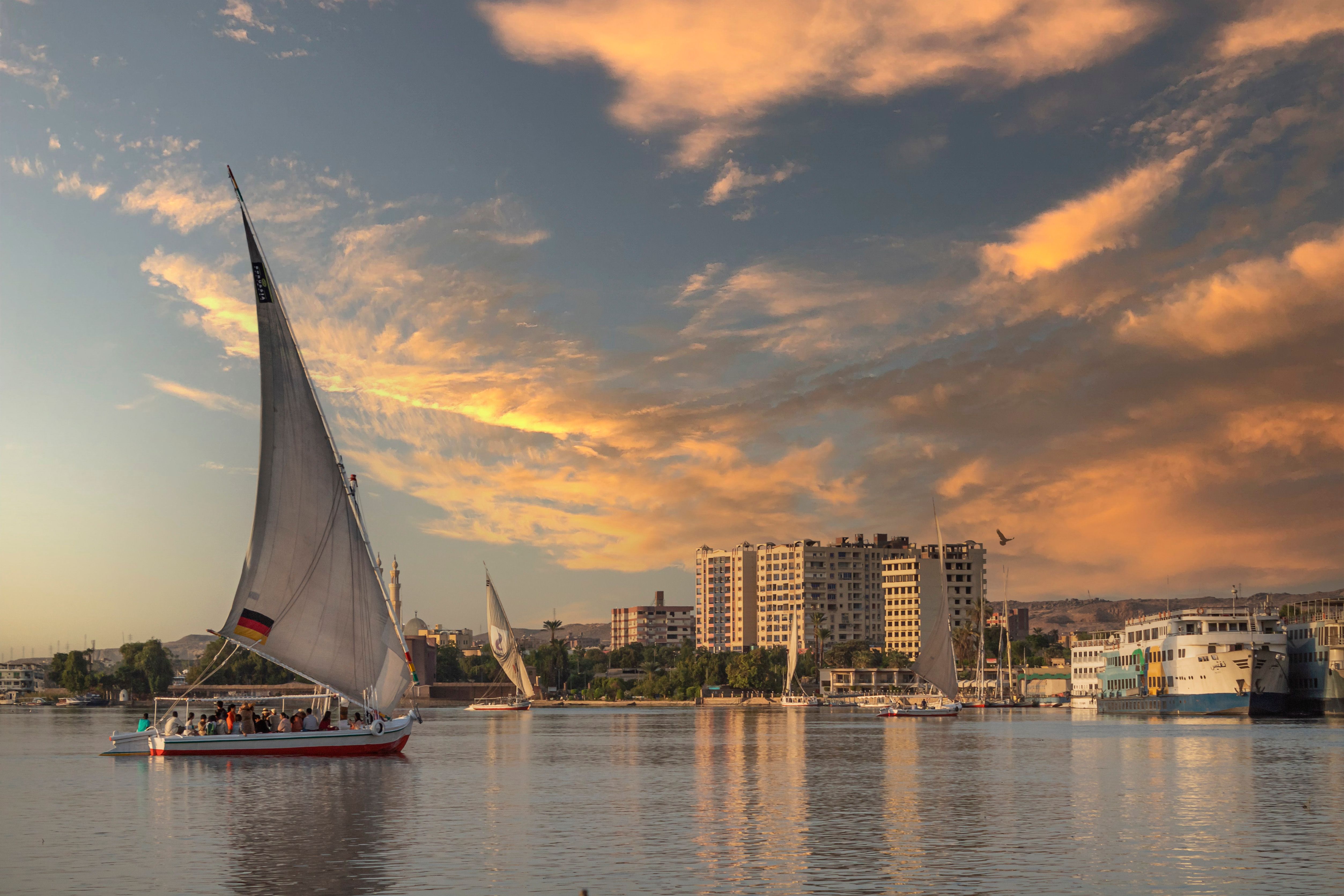
Egyptian Nile — Luxor temples at sunset and the Valley of the Kings

North Africa · The River of Civilisation

Egyptian Nile

Karnak's 134-column Hypostyle Hall. The Valley of the Kings at dawn before anyone else arrives. Abu Simbel's colossal Ramesses in the first light it was aligned to receive 3,200 years ago. The oldest wonder, still earning it.

No need to read on

Skip ahead — plan your Egyptian Nile escape now.

Tell us your dates and your pace. Personalised suggestions, never confirmed reservations.

Plan My Escape — £19.99

The Case for Going

The longest river on earth, the oldest civilisation that left monuments, and the Nile cruise as the most historically immersive journey in travel.

The Egyptian Nile between Luxor and Aswan is the most historically dense stretch of river in the world: 300 kilometres of the Nile Valley containing more listed monuments than any equivalent area on earth. The temple complexes of ancient Thebes (Luxor and Karnak), the Valley of the Kings (where 63 royal tombs have been excavated and dozens more are presumed to remain), the Ptolemaic temples at Edfu and Philae, the double temple at Kom Ombo, and Abu Simbel's rock-cut colossi all occur within a corridor that, navigated by river, is the most magnificent archaeological journey available to any traveller.

The Nile cruise — whether on a large vessel or a traditional dahabiya — remains the only rational way to travel this corridor: the temples are river-facing, the logistics of road travel between them are complicated by distance and heat, and the experience of arriving at Edfu or Kom Ombo by water (as every visitor for 3,000 years arrived) is historically calibrated in ways that a bus transfer from Luxor cannot replicate. Howard Carter, Amelia Edwards, and Agatha Christie all took the boat.

Egypt's tourism recovery since 2020 has brought visitor numbers back to the Luxor temples but has not returned them to the overcrowded levels of 2009–2010; the Valley of the Kings at 07:00, with a private Egyptologist and the tombs essentially empty of other visitors, is the most affecting archaeological experience currently available in travel.

The Destination at a Glance

A 300-km Nile Valley corridor in Upper Egypt: Luxor (ancient Thebes) to Aswan, 63 pharaonic tombs, and a river trip that hasn't changed its essential character since the 19th century.

The Egyptian Nile itinerary typically begins and ends in Cairo — Egypt's capital (population 21 million) and the location of the Grand Egyptian Museum (Giza, opened 2023, the largest archaeological museum in the world, housing the complete Tutankhamun collection for the first time since the boy-king's tomb was opened in 1922) and the Giza Plateau (the only surviving Wonder of the Ancient World). From Cairo, the two-hour flight to Luxor Airport (LXR) or the overnight sleeper train positions visitors at the northern end of the Nile cruise corridor.

Aswan, the southern terminus of the cruise corridor, is the most beautiful city in Egypt: a granite-boulder riverscape, the Nubian villages of pale blue and ochre painted houses on the west bank, the Elephantine Island in the river, and the Old Cataract Hotel's sunset terrace (where Agatha Christie wrote parts of Death on the Nile in 1934) above the First Cataract. Abu Simbel, 300 kilometres south of Aswan, requires a separate day or overnight trip but is the non-negotiable addition to any Nile itinerary.

Best Time to Visit

When to go.

Oct – Nov

Autumn

The principal Egypt season: 22–30°C in Luxor, the temples uncrowded compared to the Christmas peak, and the light excellent for photography. The annual Nile flooding has receded, leaving the riverside fields green.

Feb – Mar

Winter

The coolest season: 18–24°C in Luxor, with cool nights on the Nile. The most comfortable for extended temple walking. Post-Christmas rates lower than December–January. The Nile cruise boats running at full capacity.

Our Pick

March

The optimal combination: cool enough for full-day temple exploration (25–28°C), the winter tourist peak fading, and the Abu Simbel equinox alignment (22 October and 22 February are the astronomical dates, but March light on the temples is exceptional).

Where to Stay & Sail

Five worth knowing.

01

Oberoi Zahra — Luxury Nile Cruiser

Luxor to Aswan, River Nile

The most refined large Nile cruise vessel in operation — 27 suites on four decks, with a sun deck pool, butler service for each suite, and a dining programme that is the most accomplished of any Nile cruise boat. The Oberoi Zahra follows the classic Luxor–Aswan route (or reverse) over four or seven nights, with private guided shore excursions (the Oberoi's Egyptologist guides are the most senior in the Nile cruise sector) at Luxor, Edfu, Kom Ombo, and Aswan. The boat's ratio of space to passenger is the highest of any Nile cruiser; the upper deck Jacuzzi at sunset with the west bank cliffs in the distance is the defining Nile evening.

Best for

Couples who want the most refined and most space-generous large cruise vessel on the Nile — the Oberoi Zahra's butler-service suites and Egyptologist guide quality are the best available in the Nile cruise category.

02

Sanctuary Sun Boat IV

Luxor to Aswan, River Nile

Sanctuary Retreats' flagship Nile vessel — 36 cabins in a colonial-era aesthetic (teak decking, rattan furniture, white canvas shading) that references the steam-powered Nile cruisers of the 19th century that Agatha Christie boarded in 1937 when writing Death on the Nile. The Sun Boat IV's Egyptologist programme (three resident Egyptologists aboard, rather than the single guide standard on most cruise boats) means that competing interests in the group can pursue different aspect of each temple visit simultaneously. The sundeck dining (formal white-linen dinner under the stars as the boat moors at Edfu) is the most atmospheric table setting in Egypt.

Best for

Couples who want the most extensive Egyptology programme at sea — three resident Egyptologists aboard provide access to simultaneous specialised tours at each temple complex.

03

Nour El Nil Dahabiyas

Luxor to Aswan, traditional dahabiya

A fleet of five traditional dahabiyas (sailing felucca-derived wooden boats, 10–12 passengers maximum) that navigate the Luxor–Aswan stretch over seven to fourteen nights under sail when the wind allows. The dahabiya experience — the closest available equivalent to 19th-century Nile travel, when British aristocrats and European artists hired private boats for months at a time — is fundamentally different from the large cruise vessel: meals on deck as the boat drifts past sugar cane fields and riverside villages, swimming from the boat in the river, and sleeping under canvas as the Nile air cools after sunset. Access to sites that the large cruise vessels cannot approach (shallow-water temples, village moorings) is an additional advantage.

Best for

Couples who want the most historically authentic Nile experience — the dahabiya's small scale, sailing character, and access to sites inaccessible to large cruise ships is the most immersive Egypt available.

04

Winter Palace, Luxor

Luxor, east bank

The most famous hotel in Egypt — the Winter Palace has occupied its position on the Luxor corniche since 1886, its Victorian colonial facade the single most recognisable building in Upper Egypt. Howard Carter stayed here on the nights he was not sleeping on the Valley of the Kings excavation site; Agatha Christie wrote Death on the Nile on the hotel's terrace; Tsar Nicholas II, Winston Churchill, and the entire cast of 20th-century Egyptian archaeology passed through. The rooms range from the original colonial building (the most characterful, now designated Old Winter Palace) to the modern Royal Wing (larger, less historic). Used as the Luxor base before boarding a Nile cruise.

Best for

Couples who want to begin the Egypt visit at the most historically significant hotel on the Nile — the Old Winter Palace's connection to the archaeology of Luxor and the figures of Egyptian discovery is unrepeatable.

05

Four Seasons Hotel Cairo at Nile Plaza

Corniche El Nil, Garden City, Cairo

The most accomplished luxury hotel in Cairo — 365 rooms and suites in a tower on the Nile corniche between Garden City and Zamalek, with views of the river and the Pyramids visible to the south-west on clear evenings. The Four Seasons is the correct Cairo base for the Egypt circuit: the Pergola restaurant (Mediterranean cooking at high quality, the best hotel restaurant food in Cairo), the Nile-facing spa (the most comprehensively equipped in Egypt), and the hotel's proximity to the Egyptian Museum (15 minutes by car, or walk to the Tahrir Square Metro) and the Khan el-Khalili bazaar (20 minutes) make it the logistically optimal base for the Cairo portion of any Egypt itinerary.

Best for

Couples who want the most logistically and culinarily accomplished Cairo hotel base — the Four Seasons' Nile position, restaurant quality, and proximity to the principal Egyptian Museum are the best combination in the city.

Temples, Tombs & the River

What to do.

Valley of the Kings at dawn

The Valley of the Kings on Luxor's west bank — the 63-tomb royal necropolis cut into the limestone cliffs across the river from ancient Thebes — is the most accomplished archaeological site in the world. The Valley's daily opening (06:30) is the correct time to arrive: the temperature is manageable, the coach parties from Hurghada have not yet arrived, and the interior of the tombs (particularly KV9, the Tomb of Ramesses V and VI, with the most completely painted ceiling in the Valley) has a silence appropriate to its 3,200-year antiquity. The Tomb of Tutankhamun (KV62) requires a separate ticket and is smaller and less elaborately painted than many others, but the historical resonance — Howard Carter's candle through the sealed doorway, the golden mask, the 3,000 years of undisturbed burial — justifies the wait.

Karnak Temple at dusk

The Karnak Temple complex (2.5 kilometres north of Luxor town, accessible by horse-drawn calèche or taxi) is the largest religious structure ever built: the Great Hypostyle Hall alone — 134 papyrus-form columns, the tallest reaching 24 metres, covering an area of 5,000 square metres — is larger than the Notre-Dame Cathedral in Paris. The complex was under continuous construction for 2,000 years (from approximately 2055 BCE to 30 BCE, through eighteen pharaonic dynasties), with each ruler adding to, subtracting from, or overbuilding the previous pharaoh's contribution. The Sound and Light Show (evening, after dark) is worth attending for the Sacred Lake reflection; the dawn visit (07:00, with a private guide) before the tourist groups arrive is worth more.

Felucca at sunset, Aswan

A felucca (the small traditional Nile sailing boat, lateen-rigged, with a maximum of 6–8 passengers) at sunset from the Aswan corniche — sailing through the islands of the First Cataract (the granite boulder islands south of Aswan where the Nile narrows between igneous rocks) as the sun drops behind the west bank — is the most atmospheric two-hour boat trip in Egypt. The felucca stops at Kitchener's Island (the botanical garden island planted by Lord Kitchener in the 19th century with African and Asian botanical specimens) and crosses to the Nubian village on the west bank of the Elephantine Island; the return in twilight, with the Old Cataract Hotel's lights reflected in the Nile, is the most cinematic sequence of any Egypt itinerary.

Abu Simbel at sunrise

Abu Simbel is 300 kilometres south of Aswan: reachable by the 05:30 EgyptAir day flight (40 minutes each way, returning 09:00) or by overnight convoy drive. The sunrise flight reaches Abu Simbel as the sun is rising above the desert plateau east of the temples — the same light that illuminates the inner sanctum on the equinox dates. The four 20-metre colossi of Ramesses II, cut from the living rock of the sandstone cliff, face east across Lake Nasser with the orientation set by Ramesses's architect to impress anyone arriving by boat from the south. The temples were relocated by UNESCO between 1964 and 1968 — cut into 20,000 numbered blocks and reassembled 60 metres above the original site as Lake Nasser rose — a feat of archaeological engineering with no precedent or parallel.

What to Eat and Drink

Ful medames, koshary, and the hibiscus tea that the Nile has drunk for a thousand years.

Egyptian cuisine is the most ancient food culture in the world still in continuous practice: ful medames (slow-cooked fava beans with olive oil, cumin, and lemon, eaten at breakfast throughout Egypt since at least the 12th century) and ta'amiya (Egyptian falafel, made from fava beans rather than chickpeas, the oldest form of the dish) are the two foods that Egypt has given to the world. The Nile cruise boats serve Egyptian mezze (small dishes of baba ganoush, tahini, vine leaf dolma, and pickled vegetables) before dinner each evening; on the Oberoi Zahra, this is the most accomplished mezze programme afloat.

Karkadé (hibiscus flower tea, drunk iced in summer and hot in winter, a deep magenta colour and a tartness that is medicinal rather than sweet) is the correct Egyptian drink at every time of day — more cooling than water and associated with Nubian culture that predates the pharaonic period. At the Old Cataract Hotel's terrace, Agatha Christie's favoured gin and tonic (the hotel now names a cocktail for her) is the appropriate sundowner choice; Egypt produces its own wine (Omar Khayyam, the only Egyptian label widely available at hotels) that is serviceable if not distinguished.

The Bespoke Horizons View

The most historically significant journey available to any traveller.

Egypt is not a comfortable destination — the heat, the vendor pressure, and the management of expectations around monument access all require tolerance. But the monuments themselves, for anyone with an interest in history, art, or the human capacity for ambition at scale, are simply without equal. The Valley of the Kings alone, if encountered with a good Egyptologist at dawn before anyone else arrives, changes your sense of time.

The itinerary we recommend: two nights Cairo (Grand Egyptian Museum, Giza Plateau), fly to Luxor, one night Winter Palace (Karnak at dusk), seven nights Oberoi Zahra or Sanctuary Sun Boat IV (Luxor to Aswan), one night Old Cataract Hotel Aswan, day flight to Abu Simbel, return to Cairo. Twelve nights, and every one of them earns the next.

The sun entering Karnak's inner sanctuary as it has done 3,200 mornings in a row since Ramesses ordered the alignment. The first person to see it today, and one of an infinite sequence. That is what Egypt offers.

Essential Information

The practical detail.

Currency
Egyptian Pound (EGP); USD accepted at hotels and tourist sites; carry local currency for bazaar shopping and taxi
Language
Arabic; English widely spoken in the tourist sector and by Egyptologists on Nile cruise boats
Flights from UK
5 hours to Cairo (CAI) or Luxor (LXR) from London; direct services on EasyJet (Luxor), British Airways (Cairo), EgyptAir; Hurghada also served direct for Red Sea extension
Time zone
GMT +2 (no daylight saving)
Visa
e-Visa required for UK citizens: apply online, USD 25; alternatively a visa-on-arrival (USD 25) is available at Cairo, Luxor, Hurghada, and Sharm airports
Security
The Nile Valley corridor (Cairo, Luxor, Aswan) is the most stable area of Egypt for tourism; all Nile cruise boats have security personnel on board; FCDO currently rates the Nile Valley as generally safe for tourist travel — check current advice
Temple visits
The major Luxor temples (Karnak, Luxor Temple, Valley of the Kings) require a physically reasonable walking capacity — uneven stone ground, no shade; visit before 09:00 or after 16:00 to avoid peak heat and crowd
Budget range
Oberoi Zahra from £600 per person per night (all-inclusive); Nour El Nil dahabiya from £300 per person per night; Winter Palace Luxor from £150

Frequently Asked

Questions, considered.

Plan Your Egyptian Nile Escape

Your personalised Egyptian Nile itinerary, in your inbox within minutes.

The Oberoi Zahra from Luxor to Aswan, the Valley of the Kings at dawn, Abu Simbel's sunrise colossi, and the Old Cataract Hotel's Nile terrace — the Egypt itinerary that does justice to 3,200 years of monument.

Bespoke Horizons provides personalised travel planning and itinerary suggestions. We are not a booking agent and all recommendations are non-binding.

Ready to plan your Egyptian Nile escape?

Plan My Escape — £19.99