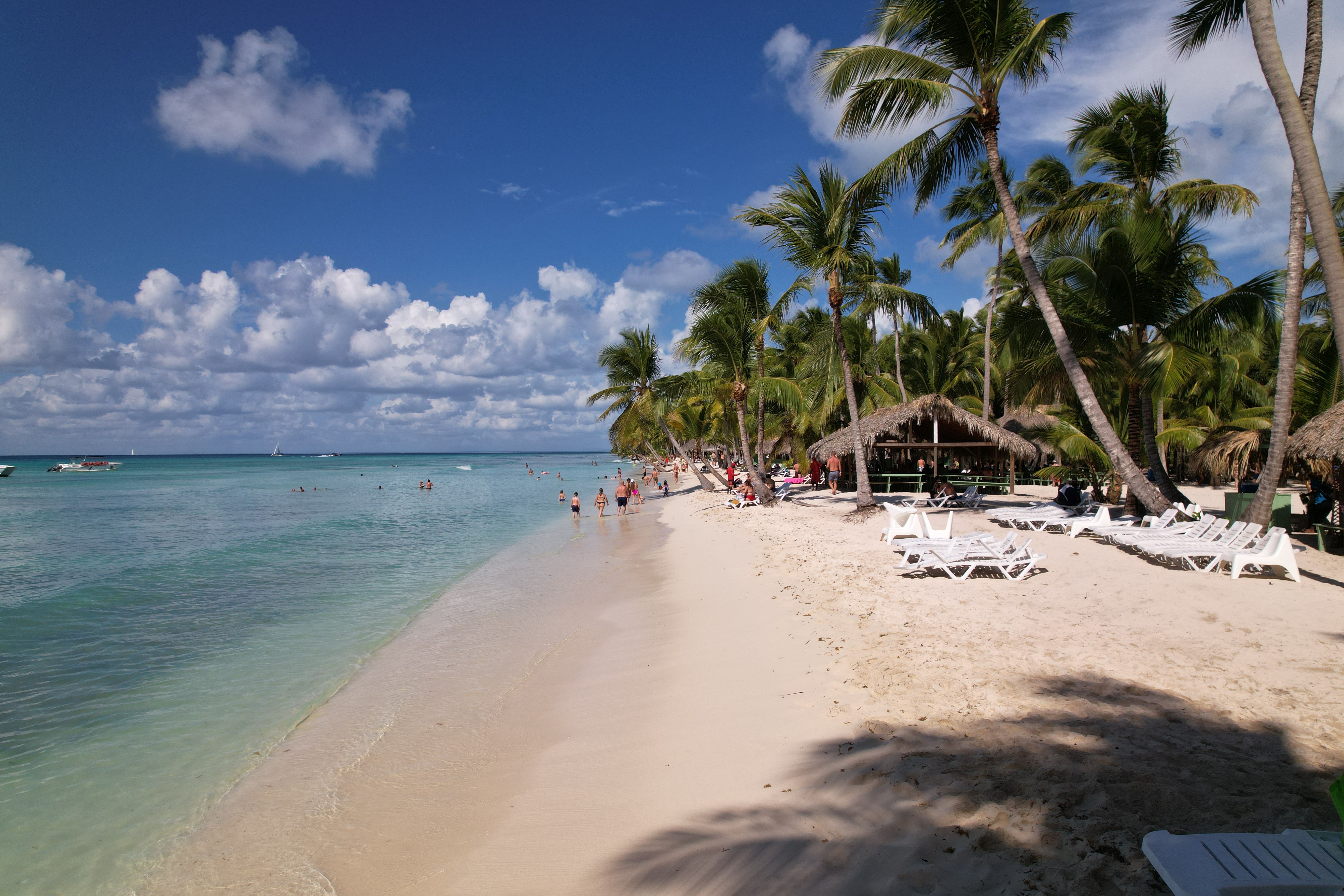
Dominican Republic — the north coast and Samana Peninsula

Greater Antilles, Caribbean · Aman, Golf & Whales

Dominican Republic

Amanera's north coast casitas, the world's largest humpback whale breeding ground at Samana, and the Caribbean's finest golf course. The Caribbean's largest island, rarely understood beyond its resort strip.

No need to read on

Skip ahead — plan your Dominican Republic escape now.

Tell us your dates and your pace. Personalised suggestions, never confirmed reservations.

Plan My Escape — £19.99

The Case for Going

The Caribbean's largest island, with more landscapes than its reputation suggests.

The Dominican Republic occupies the eastern two-thirds of Hispaniola — the Caribbean's second largest island after Cuba — with a landscape of mountain ranges, river valleys, Atlantic coast, Caribbean coast, and desert that no other single Caribbean island approaches for geographical variety. The Punta Cana resort strip, where the majority of UK visitors spend their week, is one expression of this variety; it is not representative of the whole.

Amanera on the north coast is the island's finest hotel by a significant margin: clifftop casitas above the Robert Trent Jones golf course and a private Atlantic beach of extraordinary quality, managed by a staff-to-guest ratio that the east coast megahotels cannot approach. The Samana Peninsula — two hours east of Santo Domingo, a forested cape extending into the Atlantic — is the world's most significant humpback whale breeding ground from January through March, receiving thousands of whales in a bay of thirty square kilometres.

For a couple who wants to move beyond the Punta Cana formula, the Dominican Republic has the infrastructure to support a week of genuine variety: Amanera for the beach luxury, Samana for the whale encounter, Casa de Campo for the Teeth of the Dog, and Santo Domingo for the oldest colonial architecture in the Americas.

The Destination at a Glance

The Caribbean's second largest island: 48,442 square kilometres, the oldest European city in the Americas, and 1,500–3,000 humpback whales annually.

The Dominican Republic (DR) occupies 48,442 square kilometres of Hispaniola's eastern two-thirds. The main airport is Punta Cana International (PUJ), which receives direct year-round services from London Gatwick on TUI and Virgin Atlantic (approximately 9–10 hours). Santo Domingo's Las Américas International Airport (SDQ) and Puerto Plata's Gregorio Luperón Airport (POP — nearest to Amanera) both receive direct transatlantic services in winter season.

The country has the highest mountain range in the Caribbean (Pico Duarte at 3,098 metres), the largest lake (Lago Enriquillo, below sea level), the oldest surviving European city in the Americas (Santo Domingo, founded 1498), and the Caribbean's most important whale sanctuary (Samana Bay). It is the most geographically diverse single island in the region.

Best Time to Visit

When to go.

Dec – Apr

Dry Season

The primary tourist season: consistent sunshine, low humidity, 26–30°C. January through March adds the humpback whale season at Samana. The best months for beach quality and golf at Casa de Campo.

Jun – Aug

Quieter Season

Higher humidity and occasional afternoon rain. Hurricane season (August–October) brings higher storm risk, particularly on the north coast. Lower rates at most properties; fewer visitors.

Our Pick

February

Peak dry season and the height of the Samana humpback whale season. Amanera's beach at its calmest. The Teeth of the Dog in ideal conditions. February combines the island's best weather with its most remarkable wildlife experience.

Where to Stay

Five worth knowing.

01

Amanera

Playa Grande, north coast

The Aman brand's Dominican Republic property on the north coast — a hillside of twenty-two casitas above the Playa Grande golf course and a private beach of extraordinary beauty, with views of the Atlantic from every terrace. Amanera is the most secluded of the island's luxury properties, positioned on a forested cape entirely away from the Punta Cana resort strip. The Aman Spa, the beach club, and the par-72 Robert Trent Jones golf course are the three central activities; the casitas' plunge pools and the beach at Playa Grande — a mile of reef-protected Atlantic sand entirely managed by the resort — are the four.

Best for

Couples for whom the Aman standard, the north coast seclusion, and the Playa Grande beach experience are the defining requirements — the most distinguished luxury address in the Dominican Republic.

02

Casa de Campo

La Romana, south-east coast

The original and largest luxury resort in the Dominican Republic: 7,000 acres above the Chavón River and the Caribbean, with three world-class golf courses (including the Pete Dye-designed Teeth of the Dog, regularly cited as the Caribbean's finest course), the Altos de Chavón arts village (a recreated 16th-century Mediterranean village built on the clifftop above the river as a cultural centre), a marina, a shooting range, and an equestrian centre of considerable size. Casa de Campo is the Dominican Republic's most complete resort destination.

Best for

Couples (particularly those who golf) who want the most comprehensive resort programme in the Caribbean — three golf courses, a Mediterranean arts village, and a Caribbean marina on one estate.

03

Eden Roc Cap Cana

Cap Cana, south-east

A boutique hotel of 30 rooms above the Cap Cana marina — the Dominican Republic's most ambitious private development, a planned marina community of beaches, golf, and villas on the east coast. Eden Roc Cap Cana operates as an island of calm within the larger development: the rooms face the sea, the restaurant is the marina's finest, and the spa and beach club provide the adults-only atmosphere that the larger Cap Cana hotels cannot guarantee.

Best for

Couples who want the boutique intimacy and marina views of Eden Roc within the Cap Cana development — the most refined of the south-east coast's luxury properties.

04

Sublime Samana

Las Terrenas, Samana Peninsula

A boutique hotel of 26 suites on the Samana Peninsula — the most beautiful and least developed region of the Dominican Republic, a finger of forested peninsula extending east into the Atlantic. Sublime Samana's position above Las Terrenas Beach places it within reach of the humpback whale sanctuary in Samana Bay (January through March) and the waterfall hikes of Los Haitises national park. A cooler, greener, and more culturally textured alternative to the Punta Cana resort strip.

Best for

Couples who want the Samana Peninsula's natural character — the humpback whale encounters, the peninsula's bohemian European-influenced culture — in a boutique property of genuine quality.

05

Tortuga Bay Puntacana Resort

Punta Cana, east coast

Oscar de la Renta's intimate hotel within the larger Puntacana Resort: thirteen villas designed by the late fashion designer in his signature tropical aesthetic, with private pools, direct beach access, and the most personal service in the Punta Cana region. The Tortuga Bay villas are managed separately from the main Puntacana Resort, with a private dining programme and access to the resort's facilities (golf, water sports, spa) without the obligation to share the main resort spaces.

Best for

Couples who want the Oscar de la Renta villa aesthetic in a Punta Cana setting — the most design-considered of the east coast properties, with the privacy of the villa configuration.

Whales, Golf & Colonial History

What to do.

Humpback whale watching at Samana Bay

The Silver Bank Sanctuary and Samana Bay — a protected marine sanctuary and bay respectively on the Dominican Republic's north and north-east coast — are the world's most important humpback whale breeding and calving grounds. Between January and March, 1,500 to 3,000 humpbacks arrive in the bay: males singing, mother-calf pairs resting at the surface, competitive groups of males pursuing females in behaviours that produce the whale watching world's most dynamic encounters. Boat trips from Samaná pier; responsible operators maintain 50-metre distances. The encounter with 40-ton animals singing ten metres from the boat in clear Atlantic water is among the most affecting natural experiences available to a traveller.

Teeth of the Dog golf

The Pete Dye-designed Teeth of the Dog course at Casa de Campo — opened in 1971, par 72, seven holes directly on the Caribbean Sea — is the most celebrated golf course in the Caribbean and one of the finest in the Americas. The 'teeth' are the coral rock formations that Dye incorporated into the design as natural hazards; the holes above the sea require precise driving to greens that have the Caribbean visible on three sides. Booking through Casa de Campo is required; tee times at peak season need advance reservation.

Los Haitises National Park

Los Haitises National Park on Samana Bay's south coast is a karst landscape of extraordinary biological richness: limestone mogotes (haystack hills) rising from the bay above mangrove estuaries, cave systems decorated with Taíno indigenous drawings dating to 1200 CE, and a bird list of Caribbean significance — the roseate spoonbill, the scarlet ibis, and the endemic Hispaniolan parrot. A boat tour through the mangrove channels and into the Cueva de la Línea and Cueva del Ferrocarril caves is the most comprehensive natural experience on the Samana Peninsula.

Zona Colonial of Santo Domingo

The Zona Colonial — the 16th-century planned city on the west bank of the Ozama River — is the oldest continuously inhabited European settlement in the Americas, founded in 1498 by Bartholomew Columbus. The Catedral Primada de América (1512), the Alcázar de Colón (Diego Columbus's palace), and the Museo de las Casas Reales (the former Royal Court) are the anchor sites; the neighbourhood around them — colonial Spanish gridded streets of churches, monasteries, and mansions in a state of gradual restoration — provides the most concentrated historical experience in the Caribbean.

What to Eat and Drink

Sancocho, fresh plantain, and the rum that built the island.

Dominican cooking is a hearty, Spanish-influenced Caribbean cuisine built around the combination of rice, beans, and meat (la bandera — the flag — is the everyday rice, red beans, and stewed meat plate that functions as the national lunch). The sancocho — a slow-cooked stew of seven meats with root vegetables and plantain, traditionally eaten at celebrations — is the most complex preparation in the Dominican kitchen and the version at Adrian Tropical in Santo Domingo (a restaurant on the Malecón, the sea-front promenade, serving the most traditional cooking in the capital) is the definitive interpretation.

Mama Juana — a local drink prepared by infusing rum, red wine, and honey with tree bark, roots, and herbs in a sealed bottle, sold at roadside stalls and presented as a health tonic, aphrodisiac, and general restorative — is the Dominican Republic's most culturally specific beverage and is acquired taste in the truest sense. The Brugal rum distillery (Puerto Plata, near Amanera) operates tours that explain the rum production cycle of the largest rum producer in the Dominican Republic; the Brugal 1888 expression (an aged Dominican rum of considerable depth) is the product that repays the visit.

The Bespoke Horizons View

The island that repays the research it rarely receives.

The Dominican Republic is rarely understood as a luxury destination beyond Punta Cana, which is why Amanera operates at below its deserved recognition. The combination of the north coast's forested cape, the Atlantic beach at Playa Grande, and the Aman service at a price point below comparable properties in Bora Bora and the Maldives makes it one of the best-value luxury addresses in the Caribbean.

We build the February itinerary around Amanera for the beach and golf, a two-night Samana extension for the whale encounter (the most dramatic natural experience in the Caribbean in the January–March window), and the Santo Domingo day trip for the colonial history. This covers three completely different expressions of the island in a ten-night stay.

A 40-ton humpback whale singing ten metres from the boat in Samana Bay. Amanera's beach two hours west. The same island, entirely different worlds.

Essential Information

The practical detail.

Currency
Dominican Peso (DOP); USD accepted everywhere at tourist areas
Language
Spanish; English at all major hotels and tourist areas
Flights from UK
9–10 hours (direct Gatwick/Heathrow to Punta Cana on TUI, Virgin, and Thomas Cook; also via Miami)
Time zone
GMT −4
Visa
E-Ticket required for UK citizens: an online tourism declaration, no fee, completed before travel
Regions
Punta Cana (east, resort strip), Samana Peninsula (north-east, natural), North Coast (Amanera)
Humpback whales
Samana Bay is the world's most important humpback breeding ground, Jan–Mar
Budget range
£200–£1,500+ per person per night from the inclusive Punta Cana strip to Amanera

Frequently Asked

Questions, considered.

Plan Your Dominican Republic Escape

Your personalised Dominican Republic itinerary, in your inbox within minutes.

Amanera on the north coast, the Samana whale encounter in February, and the Zona Colonial of Santo Domingo — the Dominican Republic that earns the flight from London.

Bespoke Horizons provides personalised travel planning and itinerary suggestions. We are not a booking agent and all recommendations are non-binding.

Ready to plan your Dominican Republic escape?

Plan My Escape — £19.99