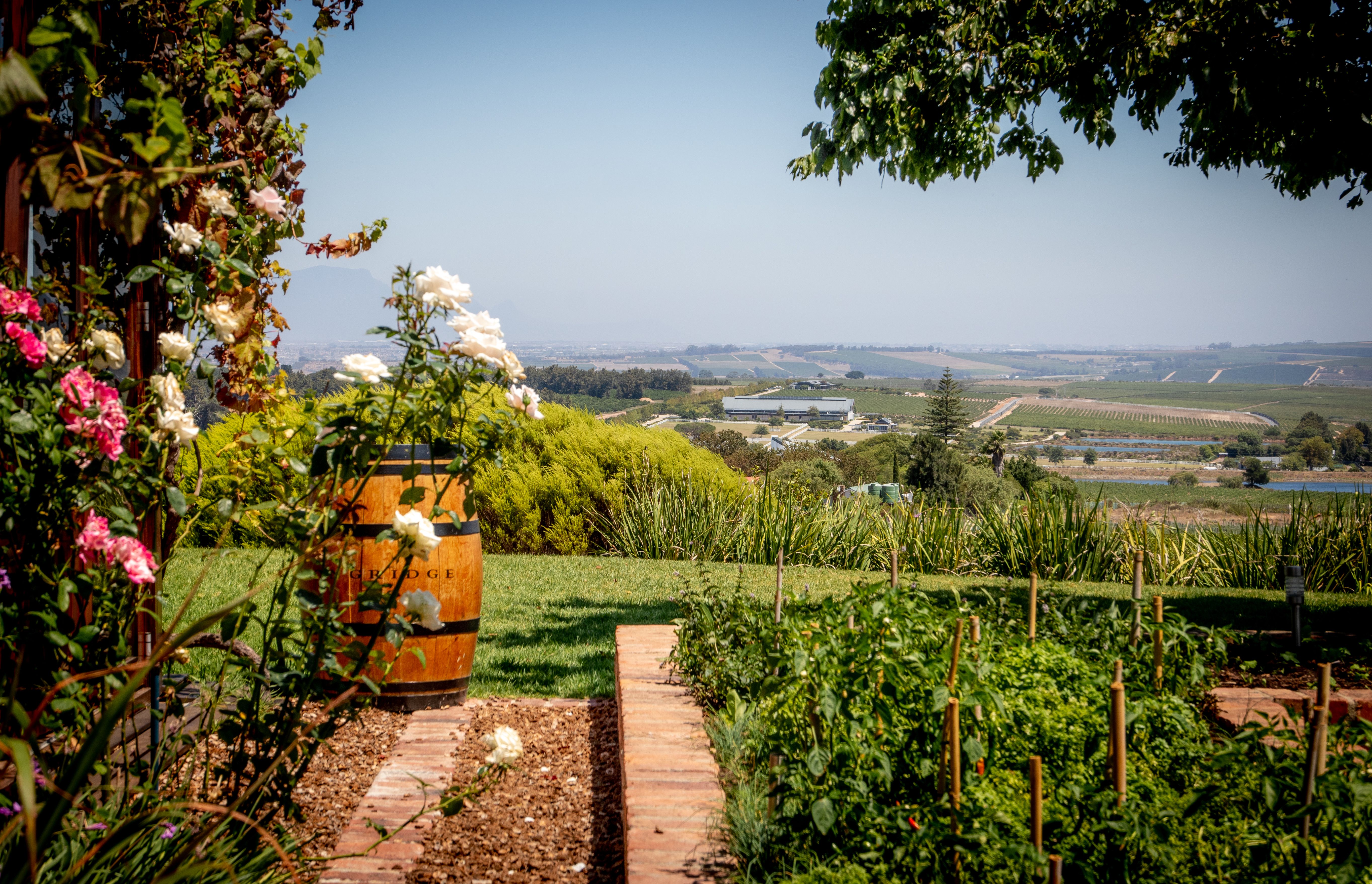
Cape Winelands — Franschhoek Valley vineyards and Cape Dutch manor houses

South Africa, Western Cape · Wine Country

Cape Winelands

La Residence's kaleidoscopic manor above the Franschhoek Valley, Babylonstoren's 300-variety food garden, and the most concentrated fine dining in Africa on a single village street. South Africa at its most seductive.

No need to read on

Skip ahead — plan your Cape Winelands escape now.

Tell us your dates and your pace. Personalised suggestions, never confirmed reservations.

Plan My Escape — £19.99

The Case for Going

Cape Dutch manor houses in a mountain amphitheatre, and a village with more acclaimed restaurants per capita than Paris.

The Cape Winelands — the wine-growing valleys of the Western Cape, centred on Stellenbosch and Franschhoek — are the most improbable wine destination in the world. Founded by French Huguenot refugees in 1688 (Franschhoek means 'French corner' in Afrikaans), the valley produces wine from terroir shaped by the Franschhoek Mountains on three sides, a Mediterranean climate almost identical to Bordeaux in rainfall and temperature, and granite-and-clay soils that suit both Bordeaux varieties (Cabernet Sauvignon, Merlot) and the Cape's own signature grape, Chenin Blanc. The result — South African wine at its finest — has been known to European collectors since the 18th century when Constantia wine was the most prized in Europe after Burgundy and Champagne.

The luxury hotel infrastructure in the Cape Winelands is the most developed in Africa south of the Sahara: restored Cape Dutch manor houses dating to the 17th and 18th centuries, converted into boutique hotels with infinity pools facing the mountain amphitheatre, wine cellars open for private tastings, and a restaurant scene (Franschhoek village, population 6,000, has fourteen acclaimed restaurants on its main street) that is the finest on the continent.

The rand's historic weakness against the pound has made the Cape Winelands one of the extraordinary luxury value propositions in global travel: a room at La Residence at the quality level of a Parisian palace hotel costs a fraction of the European equivalent. The 11-hour direct flight from London is the principal barrier; those who cross it consistently return.

The Destination at a Glance

South Africa's wine country: Franschhoek valley (45 km east of Cape Town), Cape Dutch farm architecture, and Africa's finest restaurant concentration.

The Cape Winelands region encompasses three principal valleys: Franschhoek (the smallest and most culinarily concentrated), Stellenbosch (the largest and most wine-focused, with 200+ estates), and Paarl (the broadest, with the most working-farm character). Cape Town International Airport (CPT) is the arrival point; the Franschhoek valley is 75 kilometres east via the N1 and R45 (approximately 45 minutes by road, or 30 minutes via Paarl and the R303). The Winelands Shuttle (book through any hotel) provides airport transfers; a hired car is recommended for full flexibility between estates.

The Cape Winelands climate is Mediterranean (hot, dry summers; mild, wet winters), the precise conditions that produce the Cape's signature wine styles. The grape harvest runs February through April; the vine growth season is October through May. Winter (June–August) brings the Cape's rainfall, cooler temperatures, and a dramatic mountain landscape — the Franschhoek Pass and Du Toitskloof in winter mist are among South Africa's most beautiful visual experiences.

Best Time to Visit

When to go.

Feb – Apr

Harvest Season

The Cape grape harvest: the most atmospheric time on a working wine estate. Picking crews in the vineyards, the cellar running 24-hour crush, and the valley perfumed by fermentation. The summer's best weather.

Oct – Dec

Spring

The Cape spring: protea and fynbos wildflowers on the mountainsides, vineyards budding, the valley at its most vivid. Pre-Christmas shoulder rates before the South African summer holiday surge.

Our Pick

March

The late harvest: perfect summer temperatures (27°C), the vineyards still heavy with late-picked varieties, and the valley's post-carnival quiet after February's busiest period. The best combination of weather, atmosphere, and availability.

Where to Stay

Five worth knowing.

01

La Residence

Franschhoek Valley

Eleven suites and two pool suites in a Cape Dutch manor house at the head of the Franschhoek Valley — the most architecturally extraordinary boutique hotel in South Africa. La Residence's interior (a collection assembled by owner Liz Biden over three decades: Venetian mirrors, Moroccan lanterns, Murano chandeliers, Indian carved wooden screens) should not work but creates a coherent theatre of colour and pattern that is the most discussed hotel interior in the country. The mountain-facing vineyard gardens and the infinity pool above the valley floor make the view from the terrace one of the finest in the Winelands.

Best for

Couples who want the single most extraordinary interior design in South African hospitality — La Residence is the Winelands property that is consistently cited as a transformative hotel experience.

02

Babylonstoren

Franschhoek, Simondium foothills

A working wine and produce farm of 200 hectares at the foot of the Simonsberg mountain — renovated by Karen Roos in 2010 into the most beautiful agricultural hotel in Africa. Babylonstoren's defining characteristic is the eight-hectare garden (a working food production garden of 300 plant varieties, open to guests for guided tours that conclude in the farm-to-table restaurant Babel); the Cape Dutch farmstead architecture of the oldest buildings dates to 1690. The farm produces its own wines, oils, preserves, and herb preparations — all served in the restaurant and available in the farm shop.

Best for

Couples who want the full wine farm living experience — working vineyards, the most celebrated food garden in South Africa, and the farm-to-table restaurant that uses what grows 200 metres from the kitchen.

03

Delaire Graff Estate

Stellenbosch, Helshoogte Pass

The most luxurious single property in the Cape Winelands — ten lodge suites and two owner's houses on the summit of the Helshoogte Pass between Stellenbosch and Franschhoek, purchased by Laurence Graff (the diamond merchant) in 2003 and developed into a luxury estate of global standard. The art collection (Zimbabwean and South African contemporary art, displayed in the estate's private gallery) is the most significant on any South African hotel property; the wines (particularly the Laurence Graff Reserve Cabernet Sauvignon) are among the Cape's most accomplished.

Best for

Couples who want the apex of Cape Winelands luxury — the Graff art collection, the summit views over two valleys, and the most accomplished restaurant wine list in the Winelands.

04

The Leeu Collection, Franschhoek

Franschhoek village

Three properties within Franschhoek village under the Leeu Estates Collection umbrella: Leeu House (12 suites in a restored Victorian townhouse in the village centre), Leeu Estates (17 suites on a working wine estate above the village), and the Manor House (4 suites in a restored Cape Dutch homestead). The collection model allows guests to move between properties and dining venues; the Leeu Estates swimming pool (a 25-metre infinity pool above the vineyards) and the restaurants (La Petite Colombe, the Winelands' second best restaurant) are the collection's anchors.

Best for

Couples who want to be within walking distance of Franschhoek village's restaurant row while having a wine estate retreat above — the Leeu Collection's dual-campus model is uniquely flexible.

05

Akademie Street Boutique Hotel

Franschhoek village

Five cottages in a row of Cape Dutch village houses on Akademie Street — one of Franschhoek's original Huguenot settler streets, now the most charming accommodation address in the village. Akademie Street is antithetical to the luxury hotel model: no restaurant, no spa, no pool, no concierge desk; instead five beautifully restored cottages with private gardens and all the best restaurants of Franschhoek's Main Road within a seven-minute walk. The owner, Marjolein, provides the kind of guest welcome that no large hotel can replicate. For couples who find full-service hotels suffocating.

Best for

Couples who want the most intimate and authentic Franschhoek experience — a village cottage on Akademie Street, breakfast in the private garden, and the Winelands' best restaurants steps from the door.

Wine, Food & Landscape

What to do.

Franschhoek restaurant circuit

Huguenot Road in Franschhoek village contains more acclaimed restaurants per linear metre than any other street in Africa: The Tasting Room at Le Quartier Français (Margot Janse's tasting menu, the most technically rigorous in the Cape), La Petite Colombe (Leeu Collection, Relais & Châteaux, the most consistently decorated restaurant in the Winelands), Foliage (Christopher Erasmus's hyper-local foraging menu), Reuben's (the accessible classic), and Bread & Wine at Môreson estate (the best casual lunch destination in the valley, with a wine list matching only what the farm produces). The village is walkable; four restaurants of genuine quality are within a five-minute stroll of any Franschhoek village address.

Wine estate tasting circuit

The Franschhoek valley's fourteen wine estates (most with cellar-door tasting rooms open to visitors) include: Boekenhoutskloof (the most critically acclaimed Cape producer, known for Syrah and Semillon); Mullineux (Swartland, technically a day trip but worth it for the Granite Syrah); Haute Cabrière (the most dramatically situated tasting room, cut into the rock face of the Franschhoek Mountain by Pierre Jourdan); and Babylonstoren (the most beautiful wine estate in Africa, where the tasting is conducted in the cellar beneath the original farmhouse). The Franschhoek Wine Tram (a converted hop-on-hop-off tram system connecting the valley estates) makes the wine route accessible without driving.

The Babylonstoren garden

Babylonstoren's eight-hectare walled kitchen garden — a formal food production garden planted with 300 varieties of fruit, vegetable, herb, and medicinal plant organised into formal beds around a central water feature — is the most extraordinary food garden in Africa and one of the most visited horticultural sites in South Africa. The guided tour (90 minutes, conducted by the farm's trained garden team) explains the historical provenance of each planting area, the cooking uses of the rare varieties, and the farm's philosophy (zero-waste, seed saving, natural fertilisation from the farm's own compost and animal waste). Breakfast at Babel after the garden tour is the correct sequence.

Cape Dutch architecture

The Cape Dutch architectural style — whitewashed gabled facades, thatched roofs, and symmetrical plans developed by Dutch settlers from 1652 onwards — reaches its finest expression in the Winelands: the Groot Constantia homestead (1685, the oldest wine estate in the New World and the first to produce wine from locally grown grapes), the Boschendal Manor House (1812, the most architecturally complete Cape Dutch homestead in private ownership), and the Huguenot Memorial Museum in Franschhoek village (a collection of historic Cape Dutch buildings around a central courtyard) together form the most concentrated collection of pre-colonial architecture in South Africa. A morning's drive connecting these three properties covers the essential Cape Dutch survey.

What to Eat and Drink

Chenin Blanc, Cape Malay bobotie, and a tasting menu that references the fynbos biome.

The Cape Winelands cuisine is a fusion of Dutch, French Huguenot, Cape Malay, and indigenous Khoikhoi cooking traditions — a culinary history of considerable complexity that the best Franschhoek restaurants are now mining seriously. Cape Malay cooking (brought to the Cape by enslaved workers from the Dutch East Indies in the 17th and 18th centuries) contributes: bobotie (a sweetly spiced minced meat bake with egg custard topping, the Cape's most distinctive dish), bredie (a slow-braised meat and vegetable stew with aromatic spicing), and koesisters (a syrup-soaked doughnut of Malay origin that appears at every Cape farm table). The Cape's indigenous fynbos biome contributes: rooibos tea (served at every hotel and restaurant), buchu (a herb with medicinal properties used in gin production and as a cooking aromatic), and various protea species used decoratively and gastronomically.

The wine: South African Chenin Blanc is the world's most varied white wine variety, capable of everything from everyday dry whites to the complex, mineral expressions of the Swartland's old-vine bushvines. Boekenhoutskloof's Chocolate Block (a Syrah-based blend) is the Cape's most recognised red. The Constantia valley (between Franschhoek and Cape Town) produces the Klein Constantia Vin de Constance — a sweet Muscat in continuous production since 1685, the wine Jane Austen and Napoleon both knew.

The Bespoke Horizons View

The most undervalued luxury destination in the world.

The combination of rand value, the quality of the hotel infrastructure, and the restaurant scene's concentration makes the Cape Winelands an argument that is difficult to counter: for what La Residence costs in rands, you are purchasing an experience that would cost three times as much in Provence or Tuscany, in a setting of comparable natural beauty with access to food and wine of equivalent quality.

Our recommendation: four nights in Franschhoek (La Residence for the theatrical hotel experience, or Babylonstoren for the working farm immersion — ideally both, two nights each) combined with three nights in Cape Town. The Tasting Room dinner on night two. Babylonstoren garden tour on morning three. Delaire Graff lunch on day four. The Cape Winelands is the last great wine tourism destination that most European travellers haven't discovered.

The Franschhoek valley at harvest: the vine rows red-turning, the cellar fermenting, and the mountain behind. Burgundy's weather, Africa's scale, and a table that does both justice.

Essential Information

The practical detail.

Currency
South African Rand (ZAR); exchange is the most favourable in the world for UK visitors — approximately R22–24 per £1 (2024 rate)
Language
Afrikaans, English, and Xhosa are the three principal Western Cape languages; English universal in the hospitality sector
Flights from UK
11–12 hours direct to Cape Town International (CPT) from London (British Airways, Virgin Atlantic); approximately 45 minutes to Franschhoek from Cape Town Airport by road
Time zone
GMT +2 (SAST; no daylight saving)
Visa
No visa required for UK citizens; valid passport sufficient for stays up to 90 days
Driving
South Africa drives on the left; rental cars available from Cape Town Airport; the R45 from Paarl through Franschhoek to Stellenbosch is the core Winelands driving route
Safety
The Cape Winelands is one of South Africa's safest tourism zones; normal urban safety awareness applies in Cape Town but the Franschhoek-Stellenbosch valley is extremely safe for tourists
Budget range
La Residence and Delaire Graff from £400–£1,200 per room per night; Babylonstoren from £250; Akademie Street from £150

Frequently Asked

Questions, considered.

Plan Your Cape Winelands Escape

Your personalised Cape Winelands itinerary, in your inbox within minutes.

La Residence or Babylonstoren for the Franschhoek valley, The Tasting Room dinner, and the harvest season's most atmospheric wine estates — the Cape Winelands itinerary that earns its eleven-hour flight.

Bespoke Horizons provides personalised travel planning and itinerary suggestions. We are not a booking agent and all recommendations are non-binding.

Ready to plan your Cape Winelands escape?

Plan My Escape — £19.99