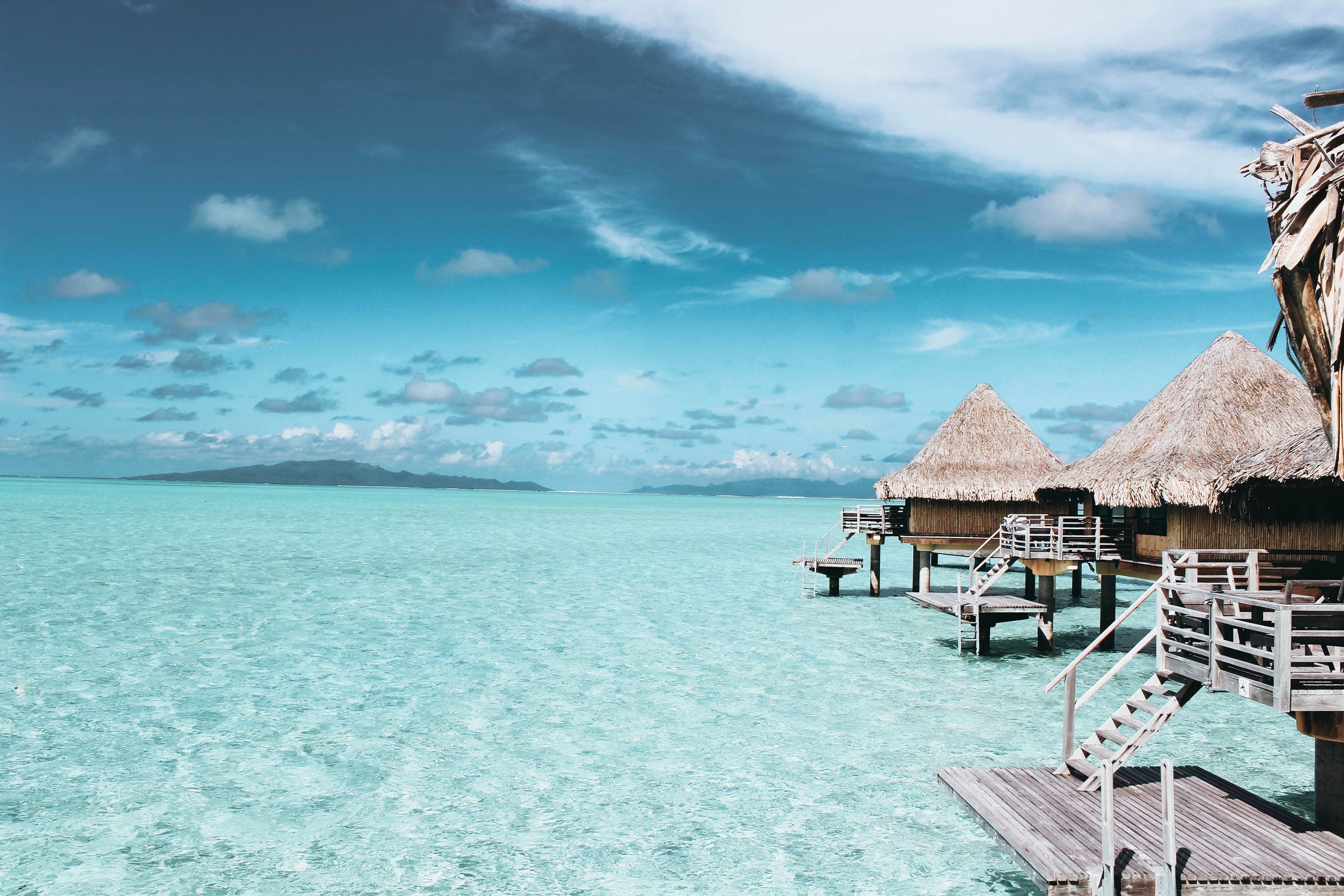
Bora Bora — overwater villas on the turquoise lagoon with Mount Otemanu behind

French Polynesia, Pacific · The Overwater Villa Origin

Bora Bora

The glass floor panel above the turquoise lagoon. Mount Otemanu's volcanic peak in the dawn light. The manta ray at the cleaning station before the tour boats arrive. The overwater bungalow was invented here. The original is still the best.

No need to read on

Skip ahead — plan your Bora Bora escape now.

Tell us your dates and your pace. Personalised suggestions, never confirmed reservations.

Plan My Escape — £19.99

The Case for Going

The island that invented the overwater bungalow in 1967 and has been the world's most imitated luxury travel image ever since.

The overwater bungalow was not a concept imported from elsewhere — it was invented in Bora Bora in 1967 by three American expats who needed to accommodate American visitors on a budget (the structures built over the lagoon required neither land purchase nor concrete foundations) and accidentally created the most widely replicated luxury travel accommodation concept in history. The Maldives, the Mayan Riviera, Fiji, the Seychelles — every tropical resort destination in the world now offers the overwater villa that Bora Bora's accidental innovation produced. None of them replicates Bora Bora exactly, because no other resort location has the combination of the turquoise lagoon (the colour produced by the white sand reef flat in shallow water refracting the sunlight upward) with the volcanic centrepiece (Mount Otemanu, the 727-metre basalt pinnacle at the island's heart, visible from every overwater bungalow on the eastern lagoon).

The Four Seasons Bora Bora resolved the question of whether luxury brands could improve on the overwater formula: the marine discovery centre (a research programme for which guests can volunteer as conservation participants), the Arii Moana restaurant (French Polynesian cuisine at a level of technical ambition previously unavailable on the island), and the villa design (the glass floor panel, the overwater deck with steps into the lagoon, the private bath above the water) represent the most comprehensive modern interpretation of what the overwater villa can offer.

The journey is 24 hours from London. The cost is significant. The experience — specifically, the experience of lying in the overwater villa in the silence of the Bora Bora lagoon at 06:00, watching the light change on Otemanu through the floor panel — is, in the testimony of most guests who make it, among the most affecting travel experiences of their lives.

The Destination at a Glance

An island of 29 square kilometres in the Society Islands group of French Polynesia, surrounded by a turquoise lagoon and a barrier reef that has been eroding and building for 7 million years.

Bora Bora's geography explains its appearance: a volcanic island 7 million years old (the same volcanic hotspot that produced all the Society Islands in sequence) surrounded by a fringing reef that has gradually separated from the island as the basalt has sunk, creating a lagoon (4–10 metres deep, the turquoise colour produced by the white sand and coral floor reflecting the sunlight upward through the shallow water column) between the island's edge and the barrier reef. The motus (coral islands) on the barrier reef — where virtually all the luxury hotels are positioned — sit between the lagoon and the deep Pacific beyond the reef.

The island's permanent population (about 10,000 people, living primarily on the main island of Vaitape) sustains the tourist economy without being entirely subsumed by it: the market in Vaitape (Tuesday, Thursday, Saturday) and the pearl boutiques (Bora Bora is in the heart of the Tuamotu black pearl farming region — the Tahitian black pearl, grown in the black-lipped oyster, is the most valuable pearl produced anywhere in the world) provide the most authentic engagement with Polynesian daily life available from the motu hotels.

Best Time to Visit

When to go.

May – Oct

Dry Season

Lower humidity, less rainfall, and the clearest lagoon water of the year. The most popular period and the highest prices. The snorkelling is at its clearest. Book 6+ months in advance for peak July and August.

Nov – Apr

Manta Season

The wet season: afternoon downpours, higher humidity, but the manta rays most reliably present at the lagoon cleaning stations. November–December is the manta peak. Lower rates and better availability at all properties.

Our Pick

November

The manta rays at peak activity, the rates at their post-season lowest, and the island at its quietest before the December holiday spike. The morning calm (before the afternoon wet-season showers) provides the best overwater villa dawn experience of the year.

Where to Stay

Five worth knowing.

01

Four Seasons Resort Bora Bora

Motu Tehotu, Bora Bora lagoon

100 overwater and beach bungalows on Motu Tehotu — a private motu (coral island) within the Bora Bora lagoon, with Mount Otemanu's volcanic peak visible directly from the overwater villa decks across the lagoon. The Four Seasons Bora Bora is consistently rated the finest hotel in French Polynesia: the overwater bungalow design (glass floor panels allowing lagoon-fish observation from inside the villa, the overwater deck with direct lagoon steps for snorkelling, and the private outdoor bath above the water) and the hotel's marine discovery centre (manta ray research, shark tagging, coral restoration programme with guest participation) make it the most ecologically engaged of the island's luxury properties. The Arii Moana restaurant (the finest hotel dining in French Polynesia, the tasting menu built around the lagoon's own marine species) and the Fare Hoa — the open-sided beach bar, the most atmospheric sunset-watching position on the island — complete a property that is widely considered the standard-setter for overwater luxury.

Best for

Couples who want the finest overwater villa experience in French Polynesia — the Four Seasons' Marine Discovery Centre, the Mount Otemanu lagoon views, and the Arii Moana tasting menu make it the most complete Bora Bora luxury experience.

02

The Brando

Tetiaroa Atoll, 30 miles north of Tahiti

35 villas on the private atoll of Tetiaroa — Marlon Brando's personal island, acquired by the actor in 1965 after filming Mutiny on the Bounty in French Polynesia and developed posthumously into the most environmentally sophisticated luxury resort in the Pacific. The Brando is not a Bora Bora property (Tetiaroa is a distinct atoll 30 miles north of Tahiti, accessible by private charter plane from Papeete in 20 minutes) but is the most compelling single property in French Polynesia for travellers whose priorities are ecological commitment, privacy, and the genuine island isolation that Bora Bora's increasingly developed tourist infrastructure no longer provides. The resort's energy (100% renewable, including the world's first SWAC — Seawater Air Conditioning — system using deep-ocean water cooling), the three Tetiaroa beaches (frigate bird nesting colonies, sea turtle nesting, and the most pristine reef in French Polynesia), and the villa design (each over-lagoon suite with a direct ocean-facing orientation) make the Brando the most extraordinary property in the French Polynesian circuit.

Best for

Couples who want the most ecologically significant and the most genuinely private luxury island experience in French Polynesia — the Brando's private atoll setting, the 100% renewable energy system, and the Tetiaroa reef's conservation status make it the most distinct alternative to Bora Bora's increasingly busy lagoon.

03

St. Regis Bora Bora Resort

Motu Ome'e, Bora Bora

90 villas on the largest motu on the Bora Bora reef platform — the most dramatically scaled of the island's overwater resorts, with the villa overwater walkways extending 200 metres into the lagoon from the motu's beach fringe and each villa's private deck positioned for a direct Otemanu view. The St. Regis's scale (the most extensive overwater villa complex in Bora Bora, with the longest overwater walkway and the most complete water-sports programme on the island) and the signature St. Regis butler service (a butler assigned per villa at all hours) distinguish it from the more intimate Four Seasons. The Lagoon by Jean-Georges restaurant (Jean-Georges Vongerichten's only French Polynesian outpost, the most internationally certified fine dining restaurant in Bora Bora) is the property's culinary anchor.

Best for

Couples who want the largest overwater villa complex in Bora Bora with the most extensive butler service and the island's most internationally recognised fine dining — the St. Regis's scale, Jean-Georges's Lagoon restaurant, and the 24-hour villa butler make it the most comprehensively serviced Bora Bora resort.

04

Sofitel Bora Bora Private Island

Private motu, Bora Bora

Thirty overwater bungalows on a private motu of 3.5 acres — the smallest and most secluded of Bora Bora's international brand properties, a Sofitel property that occupies an entire island within the lagoon and provides a level of guest-to-staff ratio and genuine island exclusivity that the larger resorts cannot match. The Sofitel Private Island's motu position (accessible only by the resort's private boat, with no road access to the main island of Vaitape and no day visitors) creates a more authentically private island atmosphere than the properties on the main island's eastern shore. The Te Ava restaurant (the most intimate dining room in Bora Bora, 30 covers maximum, with lagoon-view seating from every table) and the Hina Spa (the most complete spa programme on the island) are the property's two most distinguishing features.

Best for

Couples who want the most genuinely private island atmosphere in Bora Bora — the Sofitel Private Island's 3.5-acre motu occupancy, the no-day-visitor policy, and the 30-bungalow maximum occupancy make it the most secluded of the major international brand resorts.

05

Le Taha'a Island Resort & Spa

Taha'a Island, French Polynesia (adjacent to Bora Bora)

68 bungalows on Motu Mahana, a private motu of Taha'a Island — the 'Vanilla Island' of French Polynesia, 30 kilometres south of Bora Bora and typically combined with a Bora Bora stay as part of a two-resort French Polynesian itinerary. Le Taha'a is the most underrated property in the Bora Bora cluster: positioned between Raiatea and Taha'a, within sailing distance of the most pristine reef in the Society Islands (the Taha'a coral garden, protected from the tourist volumes of Bora Bora's main reef), the property's vanilla plantation visits (Taha'a grows 80% of French Polynesia's vanilla — the world's finest — and the plantation tours from the resort are the most educationally interesting excursion in the island cluster) and the private snorkel garden (a dedicated coral restoration area adjacent to the resort that provides the most reliable reef fish encounters in the Society Islands) make it the most ecologically rewarding and least crowded resort in the cluster.

Best for

Couples who want the most ecologically pristine reef and the most culturally distinctive French Polynesian resort experience — Le Taha'a's private motu position, the Taha'a vanilla plantation access, and the uncrowded coral garden distinguish it from the more heavily visited Bora Bora properties.

Lagoon, Reef & Otemanu

What to do.

Manta ray snorkel at dawn

The Four Seasons' marine biologist-led manta ray snorkel programme (departing the resort at 06:30 by private boat to the Tupitipiti Point cleaning station on the lagoon's southeast corner, before the public tour boats begin at 09:00) is the finest marine encounter programme available at any French Polynesian hotel. The cleaning stations (specific reef formations where manta rays hover in the current while small wrasse fish clean parasites from their gills — a behaviour that makes the mantas predictably stationary and closely observable) are occupied by mantas for 30–60 minutes on most mornings between November and April. The guide narrates the individual manta identification (each manta has a unique spot pattern on the ventral surface, used by the Four Seasons' marine research team for population monitoring) while the group snorkels alongside the rays at close range. This is the marine encounter for which people make the 24-hour journey from London.

Lagoon safari

The standard Bora Bora lagoon safari (a half-day boat circuit of the lagoon's most significant marine sites, typically including the Anau lemon shark nursery, the stingray feeding at Motu Piti Aau, and the coral garden snorkel at the Motu Toopua) is the most comprehensive single introduction to the Bora Bora lagoon available and, taken on a private charter from the hotel rather than the public tour boats, provides the most personally scaled version of what is inherently a group experience. The lemon sharks at Anau (2–3 metre blacktip lemon sharks that congregate in the shallow nursery area, docile and uninterested in swimmers but formidably impressive at close range) and the stingray feeding (the rays swimming through the shallows to be hand-fed by the guide, their diamond-shaped bodies visible beneath the boats) are the most photogenic encounters on the circuit.

Tahitian black pearl shopping

French Polynesia produces 95% of the world's Tahitian black pearls — the cultured pearls grown in the black-lipped oyster (Pinctada margaritifera) in the atolls of the Tuamotu Archipelago east of the Society Islands. The Bora Bora pearl boutiques (on the main island of Vaitape and within the hotel gift shops) sell the pearls at prices significantly below what they retail for in Paris or London; the Tahitian black pearl's characteristic lustre (a metallic surface quality produced by the thickness of the nacre layer) and the range of natural colours (black, grey, green, peacock, aubergine, and the most prized cherry-red overtone) make it the most distinctive jewellery purchase available in French Polynesia. The Robert Wan Pearl Museum on Tahiti (accessible on the Papeete transit day) is the best introduction to pearl grading and valuation before purchasing.

Mount Otemanu guided hike

Mount Otemanu (727 metres, the remnant volcanic plug at the centre of Bora Bora) is visible from every point on the lagoon and from every overwater villa but is accessible only by a guided hike from the main island — a half-day ascent through the interior jungle that reaches the base of the final basalt rock face (the summit itself requires technical rock climbing equipment and is very rarely ascended). The jungle approach (starting from Vaitape, accessible from the hotel by speedboat transfer) passes through the Wild Vanilla Garden (feral vanilla vines growing on the jungle floor, the Bora Bora equivalent of the Taha'a plantation) and provides the best views of the lagoon from the island's interior rather than the motu perimeter. The guide's knowledge of Bora Bora's wartime history (the island was a major US Navy base in 1942–1946, and the concrete fortifications on the lower slopes of Otemanu are still visible) adds an unexpected historical dimension to what is primarily a natural history walk.

What to Eat and Drink

The Arii Moana tasting menu, a poisson cru with coconut milk in the Vaitape roulotte, and the rum ti' punch at the overwater bar at dusk.

Tahitian cuisine is a creolised Pacific kitchen — French techniques applied to Polynesian raw materials, with the Chinese Cantonese cooking tradition (a large Chinese immigrant community arrived in French Polynesia in the 19th century for the cotton and vanilla plantations) adding a distinctive Asian influence that most visitors don't expect. The essential dish is poisson cru (fresh tuna marinated in lime juice and coconut milk, the definitive Polynesian preparation — closer to a ceviche than a sashimi in texture, the coconut milk softening the lime's acidity) available at every roulotte (the mobile food truck that parks in Vaitape's market square in the evenings) and at the Arii Moana in a significantly more technically accomplished version.

The Brando's food programme (the most complete and most research-driven at any French Polynesian resort, using organic produce from the island's kitchen garden and the reef's daily catch in a French-Polynesian crossover menu developed by the resort's in-house chef team) is the most ambitious cooking available in French Polynesia outside Papeete. The ti' punch (rhum agricole from Martinique with raw cane sugar and a squeeze of lime — the standard aperitif across the French Pacific) is the correct drink at the overwater bar at 18:30, as the sun reaches the angle where it turns the lagoon water from turquoise to gold.

The Bespoke Horizons View

The destination that the rest of the world has been copying for 55 years. The original is still better than any of the copies.

Bora Bora is the destination most often described as 'clichéd' by travellers who have not been, and 'life-changing' by those who have. The cliché argument is understandable: the overwater bungalow image has been reproduced so many times in advertising, Instagram photography, and lifestyle media that the destination itself risks appearing as a set rather than a place. The counter is that images do not transmit the silence, the colour of the water at dawn, or the experience of the manta ray passing three metres below your glass floor panel.

Our recommendation: five nights at the Four Seasons is the correct minimum to justify the journey. Book the Reef Overwater Bungalow (the most directly Otemanu-facing room category), request the 06:30 manta ray programme for the first morning, and do not book the outboard boat circuit until you have spent a full day doing nothing except sitting on the overwater deck. Combine with two nights at The Brando on Tetiaroa (one of the world's most important resort properties, ecological model for the Pacific) if the budget allows.

The manta ray at 07:00. The glass floor panel. Otemanu in the first light. Bora Bora was the template for the tropical escape that the entire world has been building copies of for half a century. Standing in the original, you understand what the copies are missing.

Essential Information

The practical detail.

Currency
CFP Franc (XPF); USD not accepted; EUR accepted at some hotels; exchange at Papeete Fa'a'ā International Airport before departure to outer islands
Language
French and Tahitian; English spoken at all luxury resorts; limited English elsewhere in French Polynesia
Flights from UK
Papeete (Fa'a'ā International, PPT) is typically reached via Los Angeles (LAX) on Air Tahiti Nui (direct Papeete service) or via Paris CDG on Air France; total journey 22–26 hours. From Papeete: Air Tahiti interisland flight to Bora Bora (BOB) 50 minutes, or to Raiatea (RFP) for Le Taha'a connection.
Time zone
GMT -10 (TAHT; French Polynesia does not observe daylight saving)
Visa
No visa required for UK citizens for stays up to 90 days; French Polynesia is a French Overseas Collectivity
Climate
Tropical: warm year-round (25–30°C). Dry season: May–October (lower humidity, less rain, best snorkelling conditions). Wet season: November–April (higher humidity, afternoon downpours, the manta rays most reliably present in the lagoon in November–December).
Getting to the resort
All Bora Bora hotels require a boat transfer from Bora Bora Airport (a small island, separate from the main island of Vaitape, in the northern lagoon). The hotel speedboat meets flights; transfers take 5–30 minutes depending on the motu location.
Budget range
Four Seasons from £1,200 per villa per night; The Brando from £2,500 per villa per night all-inclusive; St. Regis from £1,000; Sofitel Private Island from £800

Frequently Asked

Questions, considered.

Plan Your Bora Bora Escape

Your personalised Bora Bora itinerary, in your inbox within minutes.

The Four Seasons' Reef Overwater Bungalow, the 06:30 manta ray programme, The Brando on Tetiaroa, and the Moorea transit stopover — the French Polynesia itinerary that makes the 24-hour journey make sense.

Bespoke Horizons provides personalised travel planning and itinerary suggestions. We are not a booking agent and all recommendations are non-binding.

Ready to plan your Bora Bora escape?

Plan My Escape — £19.99