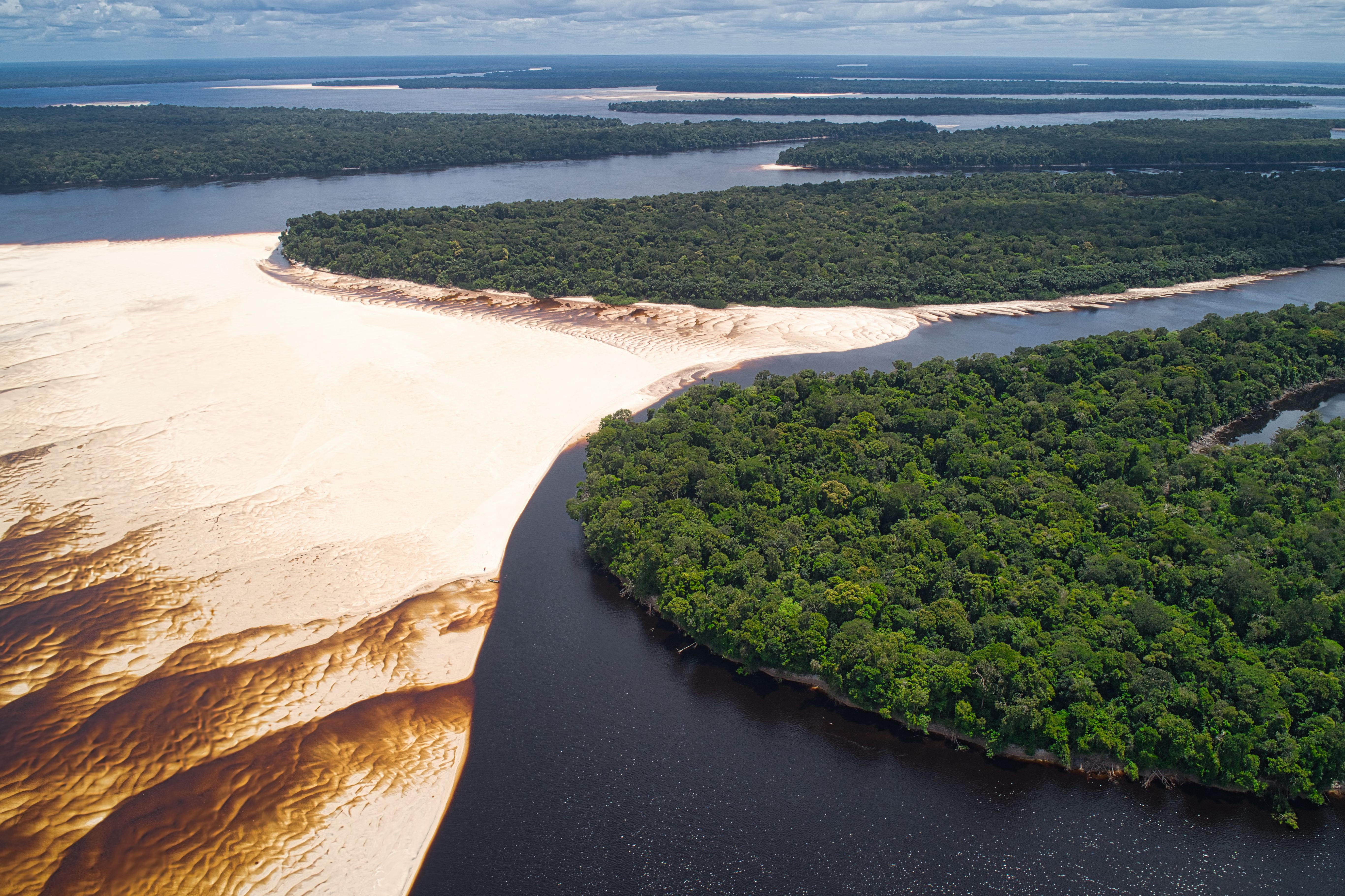
Amazon rainforest — the unbroken canopy of the world's largest tropical forest above the river

Brazil, South America · World's Largest Rainforest

The Amazon

Cristalino's 52-metre canopy tower above 630 bird species. The Rio Negro's black water at sunset in the Anavilhanas. The pink dolphin surfacing at the Juma dock. Ten percent of all life on earth lives here. You'll understand why once you're in it.

No need to read on

Skip ahead — plan your Amazon escape now.

Tell us your dates and your pace. Personalised suggestions, never confirmed reservations.

Plan My Escape — £19.99

The Case for Going

The most biodiverse ecosystem on earth, covering 5.5 million square kilometres of Brazilian territory, and home to 10% of all species catalogued by science.

The Amazon basin (encompassing parts of nine South American countries, with 60% of the Amazon rainforest within Brazilian borders) is the largest tropical rainforest on earth — a system so large that it generates its own weather, cycling 20 billion tonnes of water daily through the transpiration of its trees (a process that produces the 'flying rivers' of atmospheric moisture that feed rainfall as far south as Patagonia). Deforestation has removed approximately 17% of the Brazilian Amazon since 1970; the remaining 83% is the most biologically rich terrestrial ecosystem that has ever existed.

The Amazon's visitor infrastructure has matured significantly in the last two decades: the lodge circuit (from the internationally awarded Cristalino in the south to the community-managed Uakari in the west) offers a range of experiences from the genuinely remote to the comfortably accessible that allows travellers to calibrate their engagement with the wilderness without sacrificing the quality of the guiding or the comfort of the accommodation. What the Amazon requires is good guiding: the difference between a good Amazon guide (who can identify the 40 different monkey alarm calls, spot the leaf-cutter ant trail that leads to the nest colony, and call down a harpy eagle from its perch) and an average one is the difference between an extraordinary experience and a walk in a hot, noisy forest.

The Amazon's emotional impact is different from other natural environments: the scale is incomprehensible in photographs and only partially comprehensible from a canopy tower. The feeling from the 52-metre platform at the Cristalino, standing above the unbroken canopy with no evidence of human presence to the horizon in any direction, is one of the most affecting experiences available to any traveller on any continent.

The Destination at a Glance

The Amazon is not one place but a system: the white-water rivers, the black-water tributaries, the várzea flood forest, and the terra firme upland — each a distinct ecosystem.

The Amazon River itself (the world's largest river by volume, discharging 20% of all fresh water reaching the world's oceans into the Atlantic at its mouth near Belém) is a white-water river — its sediment-rich water giving it the yellowish-brown colour visible in satellite photography. Its major tributaries divide into white-water (the Solimões, the Madeira, the Purus) and black-water (the Rio Negro, the Cristalino, the Tupana) systems; the black-water rivers, dyed by tannins leached from decomposing leaf litter, are the most visually dramatic and the most mosquito-free Amazon environments.

The gateway cities are Manaus (the Amazon's principal city, population 2.2 million, where the Teatro Amazonas opera house — the rubber-boom-era theatre built in the jungle in 1896 — remains the most surreal landmark in South America) and Belém (the Amazon's eastern gateway, at the river's mouth, with the best food market in Brazil — the Ver-o-Peso market — and a different, more Afro-Brazilian cultural character than the interior). Most luxury lodge itineraries begin and end in Manaus; a Belém extension adds a cultural dimension to the ecological programme.

Best Time to Visit

When to go.

Jun – Oct

Dry Season

Lower water levels: beaches appear on the river banks, terrestrial wildlife concentrates at water sources, and forest trails are accessible. Peak visitor season for birdwatchers and general wildlife observation. July–September is the Amazon's peak.

Apr – May

Flood Season Peak

The flooded forest at its most dramatic: canoe between tree trunks in the várzea forest, pink dolphins in the flooded clearings, and the most extraordinary landscape in the Amazon. Lower visitor numbers, lower rates, higher humidity. The most unique Amazon season.

Our Pick

September

The water falling from its May peak but still high enough for the most dramatic river and forest landscape; the beach season beginning; and the bird activity at its most intense as the dry season concentrates avian activity around the remaining water.

Where to Stay

Five worth knowing.

01

Cristalino Lodge

Alta Floresta, Mato Grosso, southern Amazon

Thirty rooms in a private nature reserve on the crystal-clear Cristalino River in the southern Amazon — the most internationally awarded rainforest lodge in South America, a Condé Nast World Saver and National Geographic Unique Lodge that has won more conservation awards than any other Amazon property. The 63,000-acre Cristalino State Park (of which the lodge's private reserve is the ecological core) protects a transition ecosystem between the southern Amazon and the Brazilian Cerrado savanna — a zone of extraordinary bird diversity (630 species recorded in the reserve, the highest count for any single lodge site in the Amazon basin). The two canopy towers (the tallest reaches 52 metres above the forest floor, providing a 360-degree view over the unbroken canopy) and the three river ecosystems accessible from the lodge (the clear Cristalino, the black-water Rio São Benedito, and the várzea flood forest of the Rio Teles Pires) create the most varied wildlife observation environment available at any single Amazon property.

Best for

Couples who want the most ecologically rich and most conservation-credentialed lodge in the Amazon basin — the Cristalino's 630-species bird list, the 52-metre canopy tower, and the private reserve scale make it the most rewarding single-property Amazon wildlife experience available.

02

Anavilhanas Jungle Lodge

Anavilhanas Archipelago, Amazonas State

Thirty-five bungalows on the banks of the Rio Negro in the Anavilhanas Ecological Station — the second-largest river archipelago in the world (400 islands, the largest freshwater archipelago, a UNESCO-designated biosphere reserve) on the black-water Rio Negro 60 kilometres west of Manaus. The lodge's position in the archipelago (accessible only by boat from the city) provides access to the most photographically extraordinary environment in the Brazilian Amazon: the Rio Negro's dark, tannic water (dyed black by decaying organic matter, the most acidic fresh water in the world, with a pH of 4 and essentially zero mosquito population — the tannins kill the larvae) reflecting the sunsets in a way that the Amazon's white-water rivers do not. The meeting of the waters (the confluence of the dark Rio Negro and the yellowish-brown Amazon River, 10 kilometres from Manaus, where the two rivers run side by side for 6 kilometres without mixing due to their different temperatures and flow speeds) is the most visually remarkable natural phenomenon in Amazonia.

Best for

Couples who want the most visually dramatic and the most mosquito-free Amazon lodge experience — the Anavilhanas' Rio Negro black-water setting, the island archipelago landscape, and the proximity to the Meeting of the Waters make it the most photogenic Amazon base.

03

Uakari Floating Lodge

Mamirauá Sustainable Development Reserve, Amazonas State

A community-run floating lodge in the Mamirauá Reserve — the first sustainable development reserve in Brazil, a 1.1-million-hectare protected area of várzea flood forest on the Amazon-Solimões confluence near Tefé in western Amazonas State. The Uakari (named for the red-faced bald uakari monkey, a Mamirauá specialist whose range is almost entirely restricted to the reserve's flood forest) floats at water level in the reserve, rising and falling with the flood cycle (the water level varies by up to 12 metres between dry and wet season — the lodge sits on the forest floor in October and 12 metres above it in May). The lodge is managed in partnership with the local riverine communities (ribeirinhos), who provide the guides, the boats, and the cooking; the community revenue model is the most genuinely conservation-linked in the Amazon. Uakari monkey encounters are nearly guaranteed; giant river otters, black caiman, and the pink boto river dolphin are regularly seen from the floating platforms.

Best for

Couples who want the most conservation-authentic and most community-connected Amazon experience — the Uakari's community management model, the Mamirauá Reserve's biodiversity, and the flood-forest floating environment make it the most ethically distinct Amazon property.

04

Amazon Tupana Lodge

Rio Tupana, Amazonas State

Fourteen bungalows on the Rio Tupana, a black-water tributary of the Amazon west of Manaus — a smaller and more intimate lodge than the Anavilhanas, positioned on the quietest and least-trafficked section of the Amazon basin accessible from Manaus in under three hours. The Tupana's guide team (all indigenous Amazonians from the surrounding communities, speaking the regional Nheengatu indigenous language as their first language) provides the most culturally immersive Amazon experience available in the Brazilian lodge circuit: village visits, traditional fishing techniques (handlining for peacock bass and arapaima, the world's largest freshwater fish), and the caiman-spotting night excursion on the black river. The bungalows (over the water, private decks above the river, hammocks at water level) are the most atmospheric accommodations in the Manaus-area circuit.

Best for

Couples who want the most intimate and most culturally connected small-scale Amazon lodge — the Tupana's indigenous guide team, the over-water bungalow setting on the quiet black-water tributary, and the access to surrounding communities make it the most personal Amazon experience.

05

Juma Amazon Lodge

Juma Lake, Amazonas State

Twenty-six bungalows on stilts above Juma Lake, 140 kilometres south of Manaus — the most accessible luxury Amazon lodge from the Manaus international airport, built on a platform over an Amazon oxbow lake and connected by wooden walkways above the water. The Juma's position (in the várzea flood forest zone, where the water level variations are most dramatic and the wildlife most visible from the lodge's water-level platforms) provides excellent caiman-spotting from the walkways at night and piranha fishing from the dock in the mornings without requiring the boat journeys that more remote lodges demand. The treetop walkway (the most extensive in any Amazon lodge accessible from Manaus) and the pink river dolphin feeding station in the lake (boto dolphins that have habituated to the lodge's presence and surface regularly within 20 metres) are the Juma's signature attractions.

Best for

Couples who want the most accessible luxury Amazon experience from Manaus without sacrificing the over-water lodge atmosphere — the Juma's 140-kilometre proximity to the airport, the piranha fishing from the dock, and the pink dolphin feeding station make it the most logistically straightforward luxury Amazon lodge.

Canopy, River & Forest Floor

What to do.

The canopy tower at dawn

The 52-metre canopy tower at the Cristalino Lodge is the most affecting wildlife observation structure in the Amazon — a steel platform above the forest canopy, reached by a spiral staircase from the forest floor, that positions observers above the top of the trees at the level where the Amazon's bird activity is most intense in the first two hours of dawn. The 06:00 ascent (lodge guides lead small groups to the tower in darkness before the birds begin calling) coincides with the chorus of the pre-dawn period — the most biologically complex sound environment on earth, when hundreds of species begin calling simultaneously at first light. Macaws crossing the canopy in pairs. Toucans on the emergent trees. The harpy eagle (if resident, which it is at certain Cristalino territories) visible from the tower's height against the sky. And the view — the unbroken forest to the horizon in every direction, no road, no clearing, nothing but trees.

Night caiman spotting

The night caiman excursion (departing the lodge by wooden canoe at 21:00, a guide at the bow with a handheld spotlight) is the most reliably dramatic Amazon night activity and the one that most comprehensively conveys the scale of the Amazon's nocturnal wildlife diversity. The spotlight catches the reflective eye-shine of the caimans at the water's edge (red points of light at the waterline, motionless, detectable at 50 metres) while the guide identifies them by size and species — the spectacled caiman (up to 2 metres, the most common) and the black caiman (up to 5 metres, the largest predator in the Amazon basin, restricted to the larger rivers and the most isolated waterways). The same night-canoe circuits encounter the giant water lily pads (Victoria amazonica, up to 3 metres in diameter, floating on the still oxbow lakes), the firefly displays in the flooded-forest clearing, and, occasionally, the Amazon tree boa hanging above the water.

Meeting of the Waters, Manaus

The Encontro das Águas (Meeting of the Waters) is the confluence of the dark Rio Negro and the yellowish-brown Solimões River 10 kilometres east of Manaus — a natural phenomenon where the two rivers flow side by side for 6 kilometres without mixing, their different temperatures (the Negro is 28°C, the Solimões 22°C), different densities, and different flow speeds creating a visible boundary between them visible from boat level and, dramatically, from the air. The standard excursion (half-day from Manaus, combined with a visit to the Anavilhanas or a morning in the Manaus Ecological Forest Reserve) provides the most iconic Amazon visual experience available. The afternoon extension to the Anavilhanas (the black-water island archipelago of the Rio Negro, visible by boat from the Meeting of the Waters) adds the most photogenic landscape in the Amazon basin.

Flooded forest by canoe

In the wet season (November–May), the várzea flood forest — the seasonally inundated Amazon forest that covers 300,000 square kilometres of the basin — is accessible by paddled dugout canoe between the submerged tree trunks. The flooded forest is the most intimate and most surreal of all Amazon environments: the trees rising from standing water, the light filtering green through the canopy above, the surface reflections creating a mirror-image of the forest below, and the wildlife that retreats into the canopy as the water rises (monkeys, sloths, tree frogs, and dozens of bird species) visible from the canoe at eye level in the branches. The Uakari Floating Lodge's Mamirauá Reserve is the most accessible and most biodiversity-rich flooded forest environment in the Amazon; the Anavilhanas Archipelago provides an alternative version in the Rio Negro's black-water flood.

What to Eat and Drink

Tambaqui on the river bank, açaí from the Ver-o-Peso market, and the lodge kitchen's tucupi broth from the poisonous manioc.

Amazonian cuisine is one of the least documented and most distinctive regional cuisines in the world — a kitchen built around the Amazon's extraordinary fish diversity (3,000 species of freshwater fish, more than in all of Europe's rivers combined), the forest's gathered foods (Brazil nuts, cupuaçu fruit, pupunha palm heart, wild honey), and the indigenous fermentation tradition that produces the most complex flavour agents in South American cooking. Tambaqui (the large river fish, up to 30 kilograms, the 'Amazonian salmon' of Brazilian restaurant menus) grilled directly over hardwood coals with tucupi (a fermented yellow broth made from the toxic juice of the manioc root, rendered safe by boiling) is the most representative Amazonian dish.

Açaí (the purple palm berry, harvested from the Euterpe oleracea palm of the várzea forest, the most nutritionally dense food in the Amazon basin) is eaten in Belém and Manaus as a thick unsweetened paste with savory accompaniments (dried shrimp, farinha manioc flour, fried fish) — not the sweetened smoothie bowl of London's health food cafés. The Ver-o-Peso market in Belém (the largest open-air market in Latin America, on the banks of the Bay of Guajará) is the most complete introduction to Amazonian food culture: the dried herb stalls, the piranha display, the camu-camu (a vitamin C-dense berry from the Amazon's black-water lakes), and the açaí vendors who grind the berries fresh at 06:00 for the morning consumption that is a daily ritual for Belém's population.

The Bespoke Horizons View

The last wild place at the scale that changes how you think about the world.

The Amazon is not a comfortable destination by the standards of the Maldives or the Amalfi Coast. The heat is constant and significant (36°C by 10:00, humidity that makes 30°C feel tropical). The wildlife encounters require patience, appropriate guiding, and the willingness to spend time in small boats at 05:30. The logistics are genuinely complex. All of this is true.

It is also the most overwhelmingly alive place on earth, and the experience of standing in it — even for a week, at a lodge with good beds and excellent guiding — is transformative in a way that most luxury travel destinations are not. The Cristalino canopy tower at dawn, the black-water river at sunset, the caiman's eye in the spotlight at 21:00: these are not polished attractions. They are the world before people, still operating exactly as it has for 50 million years.

The forest is so loud at dawn that you cannot hear the person beside you speaking. Every species calling simultaneously, all at once, to declare themselves still alive after another night. You understand what biodiversity means when you hear it.

Essential Information

The practical detail.

Currency
Brazilian Real (BRL); USD not widely accepted outside hotels; bank ATMs in Manaus and Belém provide BRL at competitive rates
Language
Portuguese (official); indigenous languages in river communities; English spoken at lodge level, rarely elsewhere in the Amazon
Flights from UK
11–12 hours to São Paulo (GRU) or Rio de Janeiro (GIG) then connecting flight to Manaus Eduardo Gomes International Airport (MAO) 3–4 hours; total journey 16–18 hours
Time zone
Amazonas State: GMT -4 (AMT; no daylight saving). Note: the Amazon spans multiple time zones — Mato Grosso (Cristalino) is GMT -4
Visa
No visa required for UK citizens since 2024; e-visa for US-connecting flights; confirm requirements at time of booking
Climate
Equatorial: warm and humid year-round (26–36°C). Wet season: November–May (flooding reaches maximum in April–May, when the flooded forest experience is most dramatic and wildlife most concentrated). Dry season: June–October (lower water, sand beaches appear, more accessible forest trails, peak wildlife on the river banks). Both seasons have genuine appeal.
Health
Yellow fever vaccination required; malaria prophylaxis recommended for Amazon basin travel (consult a travel health clinic); dengue fever present year-round (no vaccine currently approved for adults without prior dengue infection); the Rio Negro lodges have negligible mosquito populations
Budget range
Cristalino Lodge from £400 per person per night (all-inclusive); Anavilhanas from £250 pp all-inclusive; Uakari Floating Lodge from £350 pp all-inclusive; Juma from £200 pp all-inclusive

Frequently Asked

Questions, considered.

Plan Your Amazon Escape

Your personalised Amazon itinerary, in your inbox within minutes.

Cristalino's canopy tower, the Anavilhanas sunset on the Rio Negro, the Manaus domestic connections, and the right season for the flooded forest or the wildlife beaches — the Amazon itinerary that solves the logistics before you leave London.

Bespoke Horizons provides personalised travel planning and itinerary suggestions. We are not a booking agent and all recommendations are non-binding.

Ready to plan your Amazon escape?

Plan My Escape — £19.99